
The devil is in the details: How revenue-minded CHROs drive top-line growth
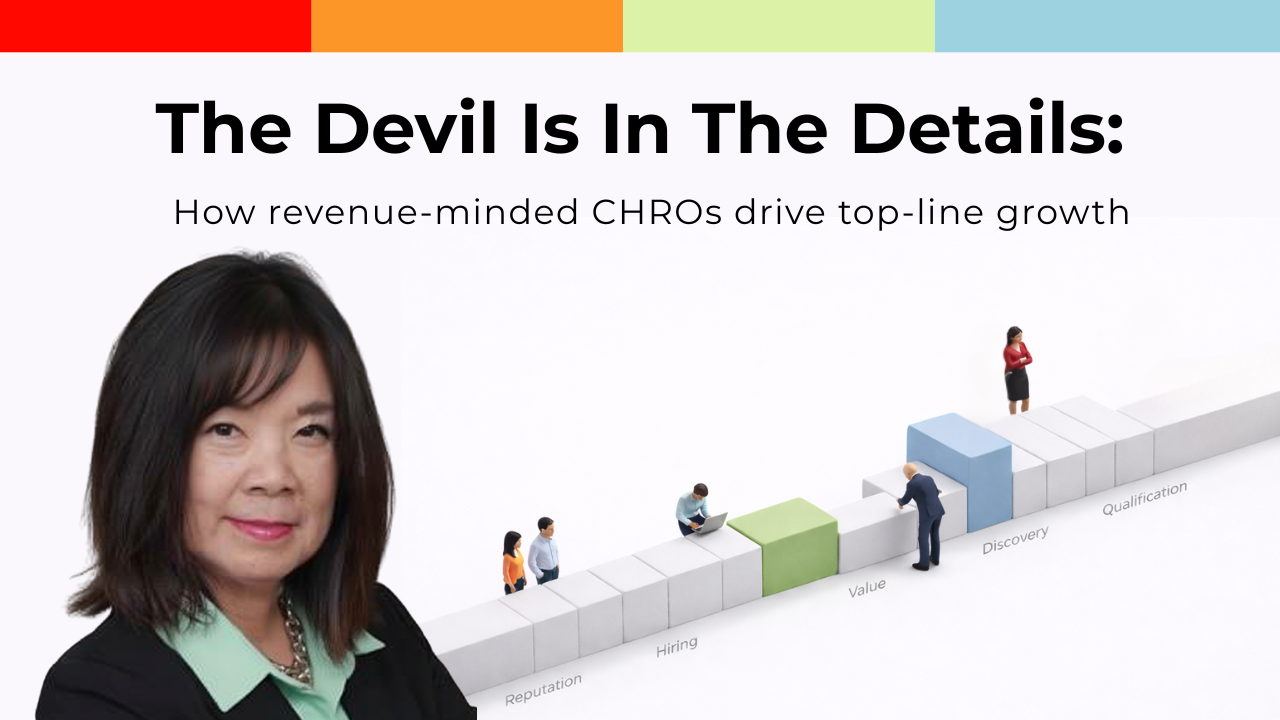
Most CHROs want to be seen as business operators. Not as the department that gets called after decisions are made.
Here’s the fastest path to credibility and growth impact:
Become a revenue-minded CHRO.
That doesn’t mean you “support sales.”
It means you can diagnose the revenue engine and fix what’s breaking with the right people levers.
And yes, the devil is in the details.
Below is a practical way to dissect a B2B sales pipeline with a talent lens, so you can pinpoint what needs to change in hiring, development, and leadership.
Why CHROs should diagnose the revenue pipeline
Revenue rarely fails at the finish line.
It fails earlier, in places most CHROs never look:
- Reputation (do great sellers want to work here?)
- Hiring and ramp (can we staff growth fast enough?)
- Value proposition clarity (do our people know what we stand for?)
- Discovery quality (can sellers create value in conversations?)
- Qualification discipline (are we chasing real deals?)
When you can diagnose these breakdowns, you become an operating leader. Not an “HR leader.”
Stage 1: Reputation is a growth lever
B2B brands do not have the consumer halo effect.
So top sales talent asks different questions:
- Is this product sellable?
- Is leadership credible?
- Is the market opportunity real?
- Will I be proud putting my name on this?
If your reputation does not attract customers, it will not attract hunters.
Research backs this up. Employer brand and reputation influence attraction and retention, which directly impacts growth execution. (Forbes)
Stage 2: Your sales pipeline starts with your people pipeline
If hiring is slow or inconsistent, your revenue plan becomes a fantasy.
A revenue-minded CHRO tracks the recruiting funnel like a sales funnel.
Example of a healthy funnel:
- Reach out to 100 candidates
- 50 respond
- 10 phone interviews
- 5 face-to-face interviews
- 3 strong finalists
- 2 offers (top candidate + backup)
What the ratios tell you:
- Low response rate = weak messaging or weak reputation
- Low screen-to-interview = wrong profile or weak screening
- Low offer acceptance = comp, speed, leadership credibility, or positioning
One “example moment” that’s real:
I’ve seen teams blame recruiters for “not finding talent,” when the real issue was the sales leader’s reputation. Strong sellers talk to each other. They know who they’re signing up to work for.
Stage 3: If the value proposition is fuzzy, performance becomes random
Sales leaders often ask for more training:
“We need better cold calling.”
“We need better prospecting.”
But the deeper question is: do we have a sharp message?
If you asked five sellers to explain your value proposition, would you get five different answers?
If yes, that’s not a training problem.
That’s a positioning problem.
And if employees do not understand your value proposition, you confuse and you lose.
Not just customers. Candidates too.
This is where CHROs have unique leverage.
You can see the global issue and convene the right functions (Sales, Marketing, Exec leadership) to fix it.
Stage 4: First meeting to second meeting ratio is a truth-teller
One of the most underrated pipeline metrics is first meeting to second meeting.
It tells you whether sellers are creating value or just pitching.
A simple benchmark:
50% of first meetings should lead to a second meeting.
If it’s below that, you likely have a discovery issue:
- sellers are not asking smart questions
- sellers are not qualifying well
- sellers are not creating insight
Another “example moment” that feels real:
A CHRO once told me, “My CRO wants more prospecting training.”
After we looked at first-to-second meeting ratios, the real issue was discovery. Reps could get meetings. They just weren’t earning the next step.
Stage 5: Proposal volume and proposal-to-close reveal qualification discipline
Proposal volume matters, but only when you interpret it correctly.
If proposals are low:
- sellers might be targeting the wrong accounts
- sellers might not be surfacing pain strong enough to justify action
If proposal-to-close is low:
- qualification is weak
- the pipeline is full of false hope
This is where I use a qualifying tool I call The Dutchman.
The Dutchman qualifying tool (for deals and candidates)
The Dutchman is an acronym that forces teams to qualify what they tend to ignore until it’s too late.
D - Decision criteria: What does “yes” require?
U - Uniqueness: Why would they choose us?
T - Timing: Why now?
C - Competition: Who else are they considering?
H - How: What will it take to meet the need?
M - Money/Budget: Is there budget?
A - Authority: Who can say yes?
N - Need: How badly do they need it?
If your salespeople cannot answer these questions, your pipeline is not real.
And here’s the CHRO connection:
If your recruiters cannot answer these questions about candidates (especially hunters), your hiring pipeline isn’t real either.
Same discipline. Same payoff.
Stage 6: Personal brand is a pipeline lever
In many B2B models, the best hunters create pipeline through credibility.
They do not rely solely on marketing.
They create demand through trust and relationships.
A revenue-minded CHRO pays attention to this because:
- it changes the talent profile you hire for
- it changes how you coach sellers
- it changes who becomes a high performer
Conclusion: What a revenue-minded CHRO does differently
A revenue-minded CHRO doesn’t guess where the people problem is.
They diagnose it.
They dissect the pipeline stage by stage and identify what’s actually broken:
- the message
- the capability
- the leadership
- the hiring funnel
- the enablement rhythm
Then they apply the right people levers to fix it.
That’s how HR drives top-line growth.
FAQ (search-style wording)
- How can a CHRO influence revenue growth?
By diagnosing pipeline breakdowns and fixing them with talent levers like hiring, ramp, enablement, and leadership capability. - What metrics should a CHRO track to improve sales performance?
Hiring funnel ratios, ramp time, first-to-second meeting rate, proposal volume, and proposal-to-close ratio. - Why does employer brand matter for B2B sales hiring?
Because hunters want to sell for companies with credibility. Reputation impacts attraction, response rates, and offer acceptance. - What is the best way to improve qualification in sales?
Use a consistent tool like The Dutchman to qualify decision criteria, need, authority, timing, budget, competition, uniqueness, and implementation. - How do you know if sales training is the real problem?
If value proposition clarity is weak, training becomes a band-aid. Fix positioning first.
Request an invite to the Big CHRO Event the 2nd Friday each September.
For CHROs, CPOs and direct reports
