
How 5 CEOs and Investors Actually Measure the Value of Their CHRO
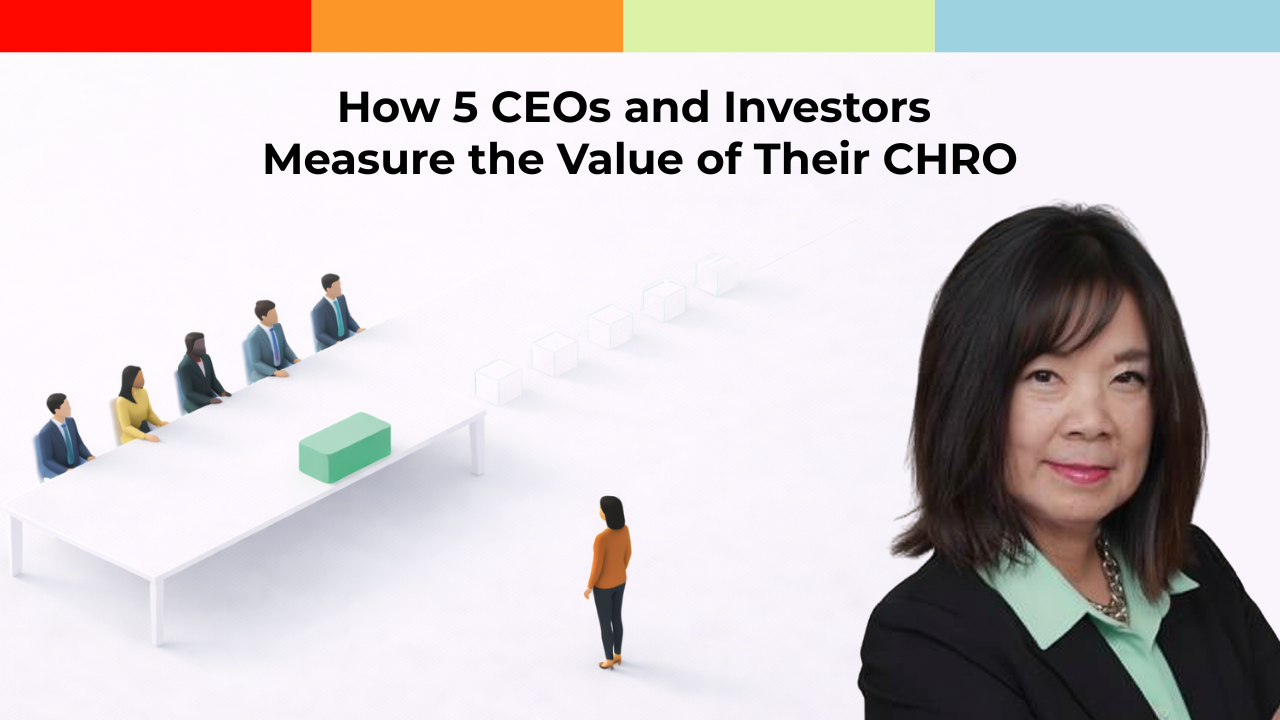
Every CHRO spends part of their career answering the same underlying question, whether it’s in an ELT meeting, a board discussion, or a quiet moment of self-reflection: am I being seen as a business leader who happens to know people, or as a people leader trying to sound like a business partner?
This question rarely gets asked directly. But it shows up in how priorities get set, what gets funded, and which leaders are trusted to weigh in on growth, risk, and tradeoffs.
Most CHROs don’t struggle with doing the work. They struggle with translating that work into the language the business already uses to make decisions.
To pressure-test this gap, I ran an experiment using Delphi, an AI platform that creates digital twins based on public interviews, writing, and decision patterns. I interviewed digital twins of five CEOs and investors and asked a simple question:
What is the biggest value a Chief HR or People Officer has brought to your organization, and how did you quantify it?
Then I followed up with the question every CHRO anticipates, even if no one says it out loud:
So no direct ties to revenue or EBITDA?
The digital twins were based on the thinking of:
Brian Halligan, Co-Founder and former CEO of HubSpot
Nikil Basu Trivedi, Co-Founder and General Partner at Footwork
Ben Greenfield, Founder of Ben Greenfield Life and former founder of Kion
Kirsten Green, Founder and Managing Partner at Forerunner Ventures
Delian Asparouhov, Co-Founder of Varda Space Industries and Partner at Founders Fund
What came back offers a much clearer playbook for how CHROs can talk about impact in business terms.
What do CEOs actually count as CHRO impact?
Short answer: outcomes, not activities.
None of these perspectives focused on programs, frameworks, or HR maturity models. They centered on speed, cost, margin, and risk.
Brian Halligan: How CHROs remove people drag that slows revenue
The digital twin based on Brian Halligan’s thinking pointed to Katie Burke, HubSpot’s first Chief People Officer, as the inflection point.
Before her, HubSpot had culture but no system. Hiring was informal. Retention was luck.
At around 150 employees, employee NPS dropped from 55 to 29. Communication broke down. Momentum slowed.
Katie operationalized culture through clear ownership, career checks, and consistent rituals. Employee NPS rebounded to 52. After IPO, instead of the expected talent exodus, HubSpot added 117 net new employees.
That stability mattered. It allowed sales to scale from $30M to $1B in ARR without people-related friction.
These were people metrics first. But the business outcome was momentum without drag.
Great CHROs don’t claim credit for revenue. They prevent the people problems that quietly kill it.
If you want to hear how these perspectives were explored and pressure-tested, the full podcast walks through each example in detail through a conversation between my digital co-hosts. The episode was developed using NotebookLM and built from Delphi digital twin interviews.
https://www.chropartners.com/blog/how-ceos-measure-chro-value
Can HR really move EBITDA?
The digital twin based on Nikil Basu Trivedi’s thinking didn’t hedge.
In one high-growth SaaS company, a people leader reduced regrettable attrition from 18 percent to under 5 percent. That preserved institutional knowledge during a 3x headcount ramp and saved roughly $2M in replacement costs.
But the more material impact came from compensation design.
After overhauling comp benchmarking and equity refresh cycles, EBITDA margins increased by eight points. Sales hires ramped faster and hit quota 25 percent sooner.
Revenue attribution was messy. EBITDA wasn’t.
This is the difference between defending HR and understanding the P&L mechanics underneath it.
What if the value isn’t a straight line to revenue?
The digital co-hosts also explored views aligned with Ben Greenfield and Delian Asparouhov, both of whom challenge the idea that HR should chase direct attribution.
From Greenfield’s perspective, the value shows up as leverage. Strong people leadership eliminates founder micromanagement and burnout. Revenue scales without proportional headcount growth. The data may be thin, but the compounding effect is real.
Asparouhov’s lens is more direct.
HR is upstream.
At Varda Space Industries, sourcing elite talent doubled revenue per head, shortened iteration cycles, and improved forecast accuracy by over 20 percent. Bad hires destroyed payback periods. Great hires multiplied output.
Don’t argue you closed the deal. Show how you built the machine that made the deal inevitable.
How does HR affect valuation?
The digital twin based on Kirsten Green’s thinking took the longest view.
Stable teams reduce cost to serve. That improves unit economics. Better unit economics improve margins and valuation multiples.
Employee health, inclusion, and sustainability show up not as sentiment, but as reduced execution risk and lower cost of capital. Investors pay more for companies that feel predictable.
The quantification lives in cohort retention curves and how they flow through the financial model.
What this means for modern CHROs
The old HR scorecard doesn’t hold up in executive rooms.
The new one looks like this:
Replacement cost avoided
Time to quota
Revenue per head
EBITDA margin movement
Forecast accuracy
You don’t need new data. You need better translation.
Happy people stay.
People who stay move faster.
Speed improves margins.
That’s not HR language. That’s business.
Listen to the full podcast
This episode was developed using NotebookLM and features a discussion between my digital co-hosts, based on Delphi digital twin interviews with five CEOs and investors on how they measure CHRO impact.
https://www.chropartners.com/blog/how-ceos-measure-chro-value
Request an invite to the Big CHRO Event the 2nd Friday each September.
For CHROs, CPOs and direct reports
