
When Talent Becomes the Revenue Constraint: Why CHROs Need to Build Talent, Not Just Buy It
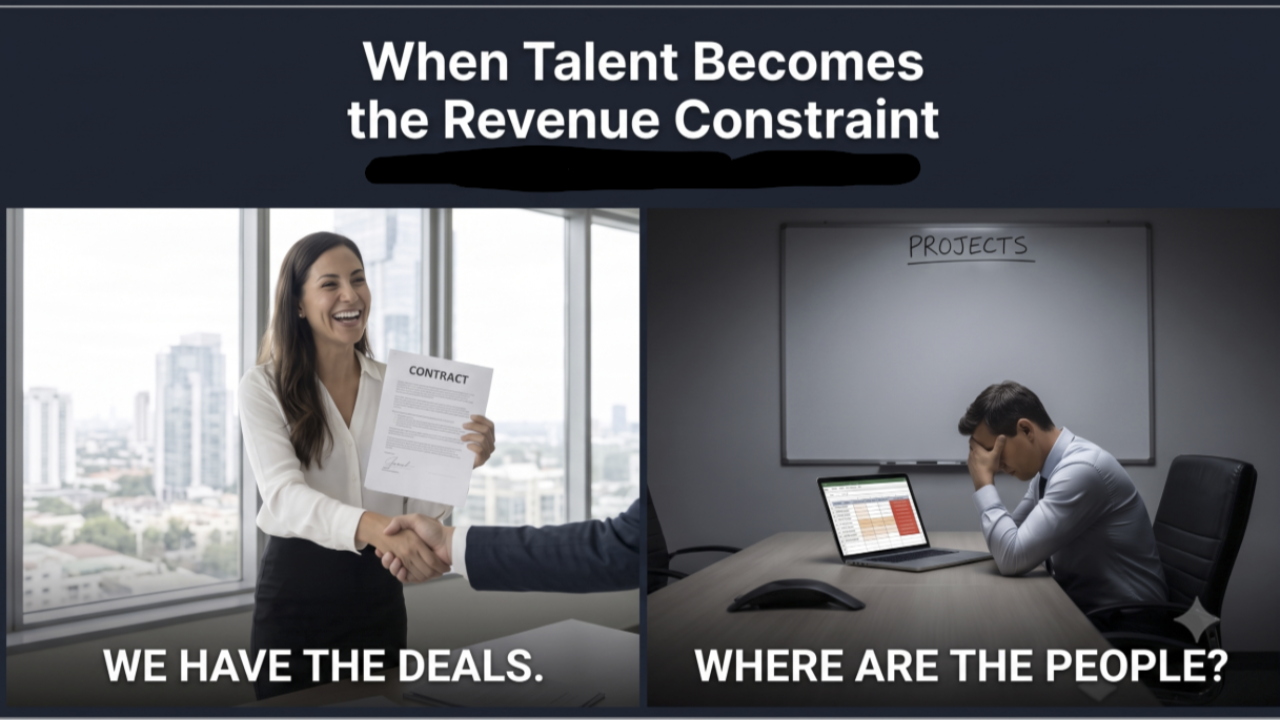
When Talent Becomes the Revenue Constraint
There are few things more frustrating in business than staring revenue in the face and having to turn it away.
I know because I have been there.
Years ago, I was running a professional services firm. We had raised capital after 9/11, and the plan was to grow the firm quickly.
And business did come back quickly.
The demand was there. The sales team was doing its job. We had deals coming in.
But we did not have the talent to deliver the work.
That experience changed how I think about talent strategy.
Because when a company has demand, customers, capital, and sales momentum, but still cannot grow, the problem is not always sales.
Sometimes the problem is talent.
And when talent becomes the constraint, it becomes a revenue issue.
What happens when talent becomes the revenue constraint?
When talent becomes the revenue constraint, the company has demand it cannot fully capture because it does not have enough ready people to deliver the work.
That is exactly what happened to us.
I had come from the Chicago market, where there was plenty of talent in our space. When I moved to Milwaukee, it was a different story.
The talent market was much smaller.
We did not have the big firms to pull from.
There were smaller shops, but not a lot of people trained in the way we delivered our services.
At first, we tried to hire our way through it.
That sounds logical.
But we were hiring too fast. We were hiring resumes. Some people had the technical background, but they were not the right fit for the way we worked.
Meanwhile, the business was stalling.
Our salespeople were bringing in deals, and we were having to say:
“We can’t start that project for weeks.”
Sometimes months.
We were stretching the people we had. We were delaying work. We were putting pressure on the business in all the wrong places.
I remember one moment very clearly.
I had gone to China to adopt my daughter. I was gone for two weeks. When I came back, we still did not have people lined up for some of the projects, and the sales team was panicking.
I remember feeling like I needed to get back to work sooner than I had planned.
I had hoped to stay home longer with my baby.
But things were not good at the office.
That was when it became clear to me that this was not just a recruiting problem.
It was a growth problem.
And more specifically, it was a revenue problem.
Why is hiring your way out of talent scarcity usually not enough?
Hiring your way out of talent scarcity usually fails because every company is chasing the same small group of people.
That is especially true in scarce skill areas.
AI skills. Data center skills. Healthcare skills. Engineering skills. Specialized technical roles.
McKinsey has found that talent is a critical constraint behind several frontier technologies, and 46% of leaders cite skill gaps as a major barrier to AI adoption. McKinsey also reported that job postings for agentic AI rose almost 1,000% from 2023 to 2024.
This is not just an AI issue.
Deloitte’s 2026 engineering and construction outlook says the industry is facing persistent labor shortages and a projected need for 499,000 new workers in 2026. Deloitte also warns that without broader and stronger talent pipelines, companies risk more project delays, cost overruns, and margin pressure.
The American Hospital Association’s 2026 Workforce Scan points to the urgent need for new healthcare talent pipelines, along with demographic shifts, geographic disparities, changing worker expectations, and rapid technology change.
That is the pattern CHROs need to pay attention to.
The talent market will not always give you exactly what you need, exactly when the business needs it.
So the better question is not only:
“Can we find the people?”
The better question is:
“Can we build the system that helps the right people become ready?”
What did we change when the perfect resume was not available?
We stopped defining talent only by who had already done the exact job before.
We changed the bar.
We hired a full-time recruiter whose job was to put 10 new face-to-face interviews in front of me every week.
But we were not just looking for resumes anymore.
We started looking for three things:
-
Attitude
-
Aptitude
-
Appreciation
Attitude
Attitude meant they had a “failure is not an option” mindset.
They were positive. They were continuous learners. They were brave enough to learn a new way of doing the work.
We needed people who could handle a fast-growth environment without needing every answer handed to them.
Aptitude
Aptitude meant they were smart.
They had critical thinking skills. They could solve problems. They could connect dots.
We used tools like Watson-Glaser and other assessments to help us see how people thought, not just where they had worked.
This mattered because the work required judgment.
A perfect resume did not guarantee judgment.
Appreciation
Appreciation meant they understood the opportunity.
They wanted to be part of a fast-growth professional services firm. They were not just looking for a job.
They wanted to build something.
That shift opened up our pipeline dramatically.
It probably 10Xed the number of people we could consider.
We started pulling people from other professions who had transferable skills. People who may not have had the perfect resume, but had the raw material to become excellent.
How do you build talent when people do not have the perfect background?
You build talent by giving people a clear system, not by throwing them into the deep end and hoping they swim.
Expanding the pipeline was only one part of the answer.
The second part was building the system around them.
We had a very specific methodology for how we delivered our services. So we outlined it.
We took the same materials we used to explain our work to clients and turned them into training materials for the team.
Then we translated that methodology into the skills people needed to build.
We created a shared language.
Every office spoke the same language.
People knew what good looked like.
They knew how the work was supposed to be done.
Junior people got guidance, feedback, client exposure, and on-the-job learning.
It was not just their direct manager helping them.
There were senior people who understood the methodology and cared about helping others be successful.
We also tied the work into our technology and dashboards, so we could actually see whether people were becoming successful.
It was not vague.
It was not “go figure it out.”
It was clear:
Here is the methodology.
Here are the skills.
Here is what good looks like.
Here is how we will know if it is working.
That is what made the talent strategy work.
Not just hiring.
Not just training.
A system.
What business result came from building talent differently?
We went from telling clients we could not start projects for weeks or months to starting projects in about five days.
I believe our average was around 4.5 days.
That changed the business.
We could respond to demand.
We could staff projects.
We could support the sales team.
We could capture revenue that we would have otherwise missed.
We also improved margins, which allowed us to carry a little more bench strength.
In consulting, that matters.
But maybe the biggest compliment was what happened next.
We became the place everyone wanted to recruit from.
That is when you know you have built something real.
Other companies wanted our people because they knew our people had been trained well.
And that made more great people want to join us, because they knew the experience would mean something in the market.
That is the flywheel CHROs should be thinking about.
Build talent well.
Create a stronger internal bench.
Serve the business faster.
Protect revenue.
Improve margins.
Become known as the place where great talent is built.
Why does this matter for CHROs right now?
This matters because talent scarcity is still showing up in the exact places companies need growth.
Even in a tough economy, there are pockets of serious scarcity.
AI is one of the clearest examples. Microsoft’s 2026 Work Trend Index says the issue is no longer just whether people can use AI, but whether organizations are built to capture the value. Microsoft’s research found only 26% of workers globally say their leadership is clearly and consistently aligned on AI.
That should get every CHRO’s attention.
Because if the constraint is skills, work design, leadership alignment, and organizational readiness, this is not just a technology issue.
It is a people issue.
And the same pattern applies outside of AI.
When companies need healthcare talent, engineering talent, construction talent, data center talent, cybersecurity talent, or specialized operational talent, they cannot assume the market will hand them enough ready-made people.
The companies that win long term will not only be the ones that can buy talent.
They will be the ones that can build it.
What should CHROs do when talent scarcity threatens growth?
CHROs should help the business move from a narrow hiring strategy to a build-and-buy talent strategy.
That means asking better questions:
-
Where could talent scarcity slow revenue?
-
Which roles are truly hard to buy in the market?
-
Which skills can be built from adjacent talent pools?
-
Where are we over-relying on perfect resumes?
-
What does “ready” actually mean in this role?
-
Do we have a clear methodology for how work gets done?
-
Do managers know how to coach people into readiness?
-
Can we measure whether people are becoming successful?
-
Are we building talent fast enough to meet business demand?
This is where CHROs can create real business value.
Not by saying, “We need more training.”
By saying, “Here is where talent could constrain growth, and here is the system we need to build so the business can capture demand.”
That is a different conversation.
And it is a much more valuable one.
What is the build-vs-buy talent strategy?
A build-vs-buy talent strategy helps a company decide which capabilities must be hired from the outside and which can be developed internally or through adjacent talent pools.
Buying talent makes sense when:
-
The skill is immediately needed
-
The role requires deep experience
-
The capability does not exist internally
-
The business cannot afford a long ramp-up
-
The market has enough qualified people available
Building talent makes sense when:
-
The market is too small
-
Everyone is chasing the same candidates
-
The company has a unique methodology
-
Transferable skills matter more than exact experience
-
The business needs a repeatable pipeline
-
The company wants stronger retention and bench strength
The mistake is treating every role as a “buy” decision.
That is how companies end up overpaying, undertraining, burning out the people they already have, and still missing revenue.
The better move is to decide role by role.
Buy where you must.
Build where you can.
And create a system that makes more people ready faster.
What is the biggest lesson from my experience?
The biggest lesson is this:
Talent strategy is not separate from growth strategy.
If the company cannot deliver the work, serve the customer, implement the technology, open the location, staff the project, or scale the function, then talent is already part of the revenue equation.
The CHRO’s job is to make that visible.
Not in HR language.
In business language.
When talent is scarce, the question is not only:
“Can we find the people?”
The better question is:
“Can we build the system that helps the right people become ready?”
That system may be the difference between turning revenue away and being ready when opportunity shows up.
For CHROs thinking through where talent scarcity may become a revenue constraint, I offer one complimentary strategy session for non-member CHROs at organizations with 500+ employees.
DM me if you want to explore where your talent strategy may need to shift from buying talent to building it.
Request an invite to the Big CHRO Event the 2nd Friday each September.
For CHROs, CPOs and direct reports
