
How CHROs Can Use AI in HR to Free Up Capacity, Reduce Risk, and Prove Business Value
Many CHROs are trying to figure out how to use AI in HR without increasing risk or overwhelming their teams.
But here’s the pattern I’ve seen over the last 30 days:
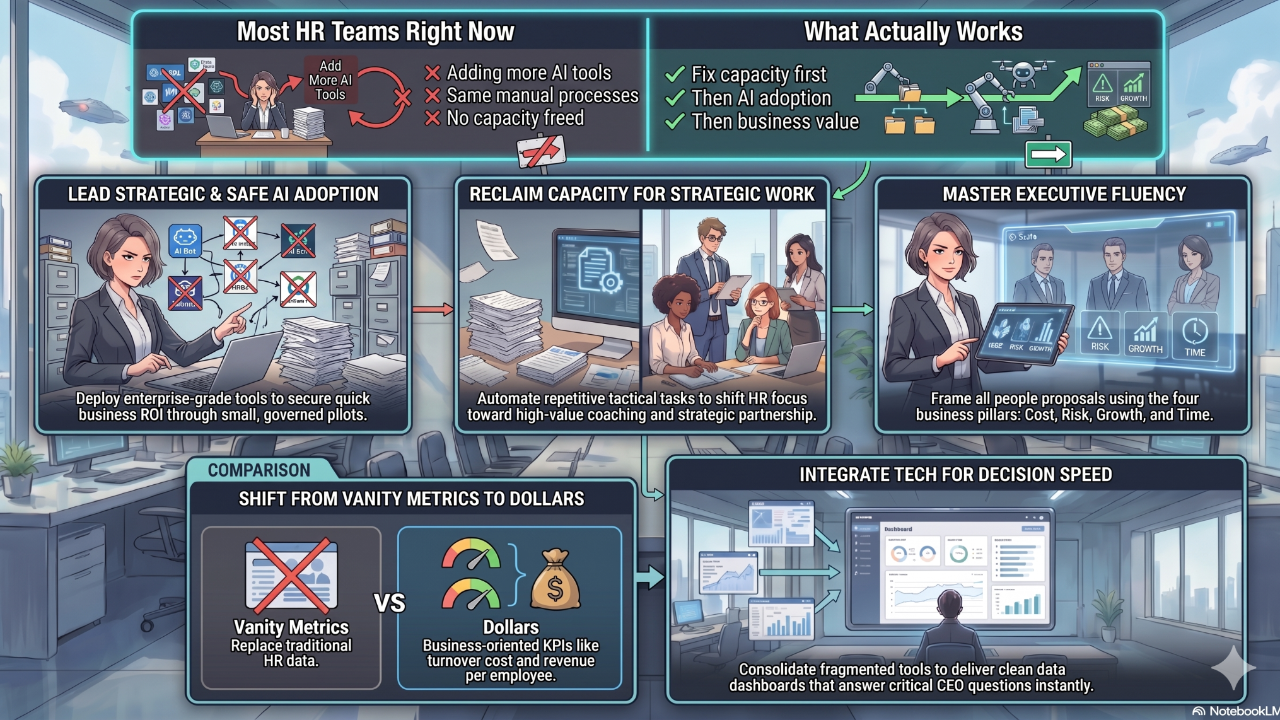
HR teams are adding AI tools on top of already broken processes.
And instead of freeing up capacity…
it’s making things worse.
More tools.
Same bottlenecks.
No real impact.
Not because executives don’t care.
Not because they’re behind.
Because they haven’t experienced how AI actually drives business results yet.
And when you haven’t experienced something…
you don’t respect it.
It’s like chocolate.
If you’ve never had really good chocolate, you don’t crave it.
That’s where a lot of executive teams are right now with AI in HR.
What is actually keeping CHROs up at night with AI in HR?
Short answer: It’s not AI itself. It’s everything around it.
What I’m seeing across CHRO and CPO groups:
- Executive teams pushing for AI without understanding the risk
- HR teams already at full capacity
- Data that is fragmented, outdated, and unreliable
- Talent models that no longer make sense
- A growing expectation to prove value in dollars, not HR metrics
One of the best descriptions I’ve heard:
The CHRO is acting like a shock absorber.
Pressure from the board and CEO on one side.
Burnout, talent gaps, and employee expectations on the other.
If that system breaks, the business feels it immediately.
Why can’t HR teams just start using AI tools in HR right now?
Short answer: Because the risk is real - and the foundation isn’t ready.
HR doesn’t deal with generic data.
It deals with:
- Compensation
- Performance reviews
- Succession plans
- Employee relations issues
If that data ends up in the wrong place, it’s not just a mistake.
It’s a legal and reputational problem.
So CHROs hesitate.
But at the same time:
Tools are still being added.
Experiments are still happening.
And without a clear sequence, this creates more noise than value.
What’s the biggest mistake CHROs are making with AI in HR?
Short answer: Adding tools before fixing capacity and process.
This is the pattern:
Instead of removing work…
teams are layering AI on top of it.
Which leads to:
- More systems to manage
- The same manual bottlenecks
- No measurable business impact
AI doesn’t fix broken workflows.
It scales them.
So if the process is inefficient…
AI just makes it faster and more complex.
What is the real blocker to implementing AI in HR?
Short answer: Your data and workflows aren’t ready.
AI only works if your data works.
But most HR environments look like this:
- Payroll in one system
- Performance data in spreadsheets
- Recruiting data in another platform
- No clean connection between any of it
So what happens?
You ask AI for insight…
and it gives you a confident answer based on bad data.
Garbage in. Garbage out.
Which means:
AI is not your starting point.
Capacity and data are.
Why does AI in HR matter right now?
Short answer: Because HR teams are out of capacity.
HR is not sitting around waiting for innovation.
They are buried in:
- Repetitive employee questions
- Manual processes
- Administrative work that keeps growing
This is why most AI efforts fail.
They don’t reduce workload.
They add to it.
The goal is not more tools.
The goal is less work.
AI only works when it removes load - not when it adds complexity.
What happens to HR roles when AI takes over tactical work?
Short answer: The generalist model breaks.
The traditional “do a little bit of everything” role doesn’t scale anymore.
What replaces it:
True business advisors.
But most companies get this wrong.
They change the title to HRBP…
without changing how the work gets done.
That never works.
The shift requires:
- Coaching on business thinking
- Better questions, not just better processes
- A different operating model
A simple signal:
More leader invitations. Fewer escalations.
If leaders bring HR in early, you’re strategic.
If they call you when things break, you’re still reactive.
Why are CHROs struggling to get budget for AI in HR?
Short answer: They’re speaking the wrong language.
Most HR metrics don’t land with a CFO:
- Engagement scores
- Completion rates
- Training hours
That’s not how decisions get made.
What works instead:
Translate everything into:
- Cost
- Risk
- Growth
- Time
Example:
Don’t say:
“Turnover is 15%.”
Say:
“Turnover is costing us $2.4M a year, and we can reduce that by $800K in three quarters.”
That changes the conversation immediately.
What is the right AI strategy for CHROs?
This is the sequence I see working right now:
Step 1: Free up capacity
Automate repetitive work
Reduce manual processes
Step 2: Adopt AI safely
Use secure tools
Clean your data first
Pilot before scaling
Step 3: Prove business value
Tie everything to cost, risk, or growth
Show measurable impact
Speak the language of the CFO
If you skip steps - or do them out of order - it breaks.
Every time.
The question CHROs are quietly asking
If we automate more…
If we focus on financial metrics…
If we start sounding like the CFO…
What happens to the human side of HR?
Here’s the reality:
This isn’t about losing the human element.
It’s about finally having the capacity to focus on it.
Right now, most HR teams are too buried to do their best work.
AI doesn’t replace that.
It creates the space for it.
Final thought
The biggest risk with AI in HR is not moving too fast.
It’s moving in the wrong order.
Because adding tools without fixing capacity first doesn’t create leverage.
It creates complexity.
The companies that get this right won’t just be more efficient.
They’ll make better decisions, faster.
And that’s where the gap starts to widen.
If you’re a CHRO trying to make AI practical inside your organization, you’re not alone.
This is exactly what we’re working through in real time inside CHRO Mastermind groups.
One takeaway to sit with:
AI doesn’t take time.
It makes time.
The question is what you’re going to do with it once you get it back.
Request an invite to the Big CHRO Event the 2nd Friday each September.
For CHROs, CPOs and direct reports
