
What CHROs Should Learn From CFOs About AI
Quick answer
CHROs should learn from CFOs that AI adoption is not a tool rollout. CFOs are treating AI as an operating model change that requires measurable use cases, workflow redesign, governance, role-specific skills, and new performance metrics.
That is the move CHROs should borrow.
Not generic AI training.
Not random pilots.
Not a “let’s get everyone using ChatGPT” campaign.
The better play is to redesign the work before AI pressure turns into rushed headcount decisions.
That is especially true in finance, where AI is already changing how work gets done, how teams are structured, and what skills matter most.
Why are CFOs ahead of many functions on AI?
CFOs are ahead because they are forcing AI into business discipline.
They are asking harder questions than “Which tool should we buy?”
They are asking:
- What value will this create?
- What process needs to change?
- What risk does this introduce?
- What controls need to stay human-led?
- What skills do we need?
- What work should shrink, shift, or grow?
That is the part CHROs should pay attention to.
According to the research report, CFOs are no longer treating AI as a side project owned by IT. They are treating it as a finance-led operating model change with three hard requirements: a visible value thesis, tighter governance, and role redesign.
That is a much better model than the way many companies are approaching AI across the workforce.
Too many companies are starting with tool access and training.
CFOs are starting with value, controls, and work redesign.
That is the difference.
What are CFOs actually doing with AI right now?
CFOs are increasing AI investment, but they are also becoming more disciplined about what gets funded.
The strongest pattern is this:
AI has to improve speed, decision quality, cost, risk management, or business outcomes.
If it does not, it should not scale.
The report found that Bain, BCG, Deloitte, Gartner, and Oliver Wyman are all pointing in the same direction: CFOs are moving away from isolated AI experiments and toward measurable use cases, better governance, and more serious role redesign.
That matters because CFOs are not just adding AI as another budget line.
They are reallocating.
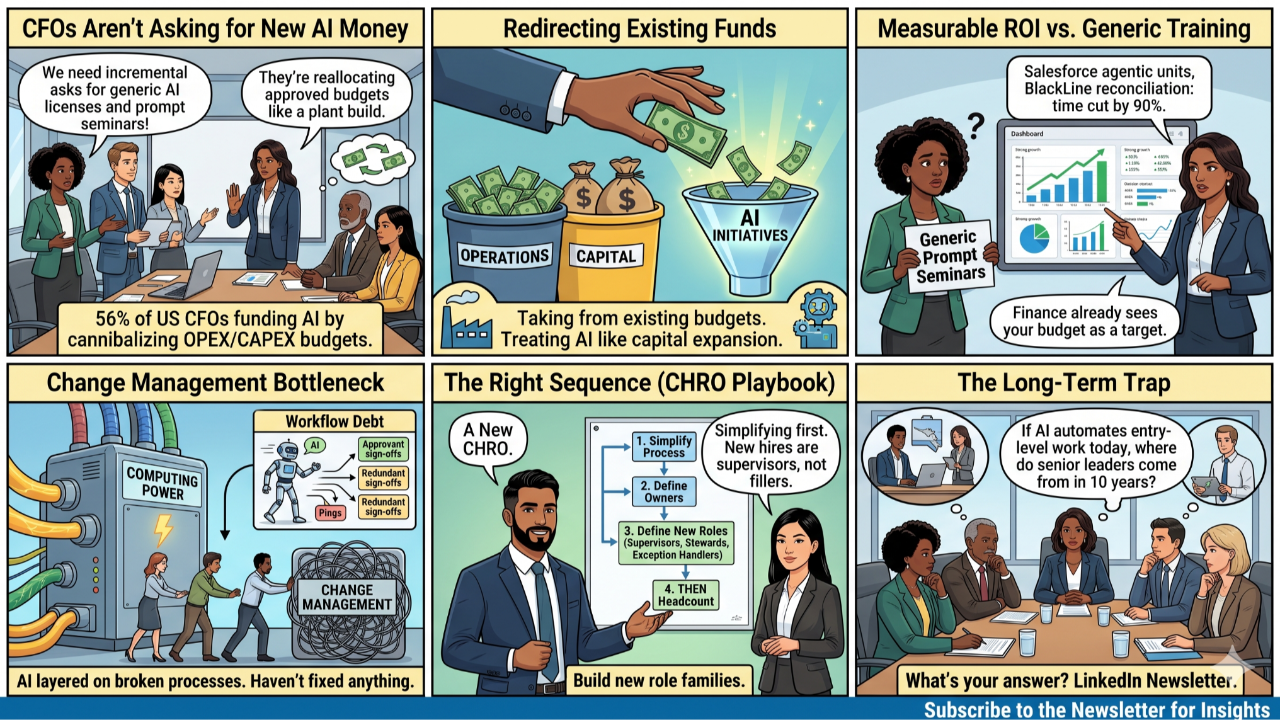
Deloitte’s North American CFO Signals showed that finance leaders are often redirecting operating expense and capital expense to fund new technology instead of relying only on blunt cuts.
That is a big lesson for CHROs.
When CFOs fund AI, they usually have to decide what to stop, what to scale, and what to measure.
CHROs should use the same discipline with workforce planning.
What should CHROs copy from the CFO AI playbook?
CHROs should copy the CFO habit of connecting AI to value, governance, and role design.
Here is the simplest way to think about it.
The CHRO Finance AI Readiness Map
Use this five-part map when working with the CFO on AI and finance talent.
1. Value
What business outcome should AI improve?
Examples:
- Faster close
- Better forecasting
- Shorter reconciliation cycles
- Faster variance analysis
- Better working-capital decisions
- More useful management reporting
Do not start with the tool.
Start with the business outcome.
2. Work
Which workflows need to change?
AI does not fix broken workflows. It usually exposes them.
If the process is messy, AI can make the mess faster.
That is why Bain’s research is so important. The report notes that many finance teams are blocked by “workflow debt,” where old processes stay in place and AI gets layered on top of them.
CHROs should help the CFO ask:
- What work should be automated?
- What work should be simplified first?
- What work still requires human judgment?
- What approval steps are outdated?
- What exceptions need clearer ownership?
3. Roles
Which jobs need to be redesigned?
This is the part HR cannot leave to finance alone.
Oliver Wyman’s CFO research found that 91% of CFOs expect finance headcount to stay flat or decrease, 64% expect a shift away from junior-heavy roles, and 47% expect more centralization and shared services.
That should get every CHRO’s attention.
The question is not just, “Will finance need fewer people?”
The better question is:
What kind of finance talent will the business need next?
AI will likely reduce some repetitive work. But it will increase the need for people who can validate outputs, manage exceptions, interpret signals, explain tradeoffs, and protect controls.
That means finance career paths may need to be rebuilt.
4. Controls
Where must human judgment stay?
Finance is not a low-risk playground for AI.
AI may help produce forecasts, reconciliations, reports, analysis, and recommendations. But finance still has audit, compliance, investor, and board-level responsibilities.
BCG’s research argues that finance AI needs data lineage, escalation rules, approval workflows, preserved segregation of duties, and human review before more autonomy is allowed.
That is not just a technology issue.
It is a role design issue.
Someone has to own the review.
Someone has to approve the exception.
Someone has to understand when the AI output is wrong.
Someone has to be accountable.
CHROs should help define those responsibilities before AI is embedded into daily work.
5. Metrics
How will success be measured?
The wrong metric is “how many employees completed AI training.”
That tells you almost nothing.
Better finance AI metrics include:
- Days to close
- Forecast refresh cadence
- Time to resolve variance questions
- Reconciliation cycle time
- Exception rates
- Control quality
- Adoption of approved AI workflows
- Accuracy of AI-supported outputs
- Business partner satisfaction
Gartner’s research says CFOs should rethink AI ROI and manage AI as a portfolio that includes productivity bets, process-improvement bets, and selective transformational bets.
CHROs should apply that same thinking to talent.
Some learning investments will improve productivity.
Some will improve controls.
Some will build future capability.
Do not force all of them into the same ROI box.
What finance jobs are most likely to change because of AI?
The finance jobs most likely to change first are the ones with high-volume, repeatable, rules-based work.
That includes work connected to:
- Reconciliations
- Close processes
- Transaction review
- Forecast updates
- Variance analysis
- Reporting
- Planning and budgeting
- Shared services
- Working-capital analysis
But here is the important part.
AI does not just remove work. It changes the work that remains.
A finance analyst may spend less time pulling data and more time interpreting what changed.
A controller may spend less time reviewing routine reconciliations and more time managing exceptions and control quality.
An FP&A partner may spend less time building reports and more time helping business leaders understand scenarios.
That means the new finance skill set is not just “AI literacy.”
It is judgment, business translation, data confidence, process thinking, and control discipline.
Should CHROs launch broad AI training for finance teams?
No, not as the main strategy.
Broad AI training can be useful as a foundation, but it is not enough.
Finance needs role-specific AI capability building.
Gartner recommends role-specific AI literacy rather than generic awareness training, and the report highlights this as one of the clearest lessons for CHROs.
A stronger finance AI learning plan would include different tracks for:
- CFO and finance executives
- Controllers and accounting operations
- FP&A and business finance partners
- Finance systems and data teams
- Shared services leaders
- Internal audit and risk partners
Each group needs something different.
Finance leaders need to understand value, risk, and resource allocation.
Controllers need to understand validation, controls, and auditability.
FP&A teams need to understand scenario modeling, business translation, and decision support.
Finance systems teams need to understand data architecture, workflow design, and AI governance.
That is why generic AI training falls short.
It creates awareness, but not capability.
What is the biggest mistake CHROs can make right now?
The biggest mistake is waiting for the CFO to bring HR in after the structure has already changed.
By then, it is late.
The headcount assumptions may already be baked.
The technology may already be selected.
The workflows may already be redesigned without enough thought about skills, career paths, manager capability, or adoption.
The better move is for CHROs to get in early and say:
“We need to redesign the work, the roles, the skills, the controls, and the metrics together.”
That is not HR slowing the business down.
That is HR helping the business move faster without creating chaos.
CHRO mastermind groups don’t take time. They make time. And this is exactly the kind of issue where peer insight can help a CHRO see around corners before the pressure hits.
What should CHROs do in the next 90 days?
Start with finance.
Not because finance is the only function AI will change, but because finance is a practical place to build the muscle.
In the next 90 days, CHROs should sit down with the CFO and answer these questions:
- Which finance workflows are most likely to be changed by AI in the next 12 months?
- Which roles will be most affected?
- What work will shrink, shift, or grow?
- What new skills will matter most?
- Where must human judgment stay in the process?
- What controls cannot be weakened?
- What metrics will show whether AI is actually improving the work?
- Which career paths need to be redesigned before junior work disappears?
Then build a simple finance AI workforce map.
Not a giant deck.
A working map.
It should show:
- Priority AI use cases
- Roles affected
- Skills needed
- Workflows that need redesign
- Human approval points
- Control risks
- Learning paths
- Performance metrics
- Succession implications
That is how CHROs move from AI conversation to AI execution.
How should CHROs think about AI and headcount?
CHROs should not be naive about headcount pressure.
It is coming.
But they should also not let AI become an excuse for lazy workforce planning.
The better question is not, “How many jobs can AI eliminate?”
The better question is:
What work should humans still do because it requires judgment, trust, influence, ethics, context, or accountability?
That question leads to better decisions.
Some work will go away.
Some work will be automated.
Some work will move to shared services.
Some work will become more technical.
Some work will become more strategic.
Some jobs will shrink.
Some new roles will appear.
The CHRO’s job is to help the business make those choices clearly, not emotionally, and not after the fact.
What company examples should CHROs pay attention to?
Several company examples from the report are useful.
Microsoft
Microsoft tied AI investment to business model change, capital planning, demand signals, efficiency, and workforce productivity. The report notes that Microsoft expected headcount to decrease year over year while AI-related spending on compute, data, and talent continued.
The lesson for CHROs:
AI investment and workforce compression can happen at the same time.
Salesforce
Salesforce connected AI to governance, board oversight, executive incentives, and AI-specific operating metrics.
The lesson for CHROs:
AI becomes real when it shows up in governance and performance management.
HPE
HPE’s CFO Marie Myers was recognized for co-developing and implementing agentic AI tools across finance, while HPE also reorganized reporting around Cloud & AI.
The lesson for CHROs:
The CFO role is expanding. Finance leaders are not just managing numbers. They are helping reshape how the business operates.
BlackLine
BlackLine framed finance AI around auditable, explainable, “glass box” capabilities instead of black-box automation.
The lesson for CHROs:
Trust is part of the operating model. If people do not trust the AI, they will either ignore it or misuse it.
What is the main takeaway for CHROs?
CFOs are showing us what serious AI adoption looks like.
It is not a tool rollout.
It is not a generic training plan.
It is not a collection of random pilots.
It is a disciplined operating model shift.
The CHRO opportunity is to bring the people discipline CFOs cannot solve alone.
That means helping the business redesign:
- Work
- Roles
- Skills
- Metrics
- Incentives
- Controls
- Career paths
- Change plans
The companies that win with AI will not be the ones with the most tools.
They will be the ones that redesign work clearly, build capability fast, protect trust, and move without breaking the business.
Finance is one of the first places CHROs can practice that muscle.
And if CHROs get this right in finance, they can use the same playbook across the rest of the company.
FAQ
What should CHROs learn from CFOs about AI?
CHROs should learn that AI needs to be managed as an operating model change, not a technology rollout. CFOs are connecting AI to measurable value, governance, workflow redesign, role changes, and performance metrics. CHROs should borrow that same discipline for workforce planning.
How should CHROs prepare finance teams for AI?
CHROs should start by mapping which finance workflows AI will affect, which roles will change, what skills will matter more, where human judgment is required, and how success will be measured. The goal is to redesign the work before making major headcount or structure decisions.
What finance roles are most likely to change because of AI?
Roles connected to repetitive, high-volume work are likely to change first. That includes accounting operations, reconciliations, close, reporting, forecasting, planning, and shared services. The work that remains will require more judgment, exception handling, control oversight, and business translation.
Is generic AI training enough for finance teams?
No. Generic AI training may create basic awareness, but finance needs role-specific AI capability. CFOs, controllers, FP&A leaders, finance systems teams, shared services leaders, and audit partners all need different skills.
How should CHROs measure AI workforce readiness?
CHROs should measure AI workforce readiness through role-specific capability, adoption of approved workflows, control quality, speed improvements, exception handling, forecast cadence, cycle-time reduction, and whether talent plans are aligned to the finance AI roadmap.
What is the biggest AI mistake CHROs should avoid?
The biggest mistake is waiting until after technology decisions and headcount assumptions are already made. CHROs need to help shape the work, roles, skills, controls, and metrics early.
Listen to the full podcast
Want the deeper version?
Listen to the full podcast episode to hear how CFOs are funding, measuring, and governing AI, and what CHROs should do now to redesign finance talent before the org chart gets rewritten for them.
This episode goes deeper into the CFO playbook and what CHROs can borrow right now to help their companies move faster with less chaos.
CHROs: Ready to stop shouldering this types of challenges alone? Book a confidential 45-minute conversation with me. Most CHROs and CPOs discover in the first call whether peer counsel is the missing piece they've been looking for.
Sources used
This blog was based on the research report, “What US CFOs Are Doing on AI and What CHROs Should Borrow.”
Sources used in the report:
- Bain - CFOs Funded the AI Revolution. Now They’re Joining It.
- BCG - The CFO’s AI Agenda: From Automation to Advantage
- Oliver Wyman Forum x NYSE - CFOs of 12% of Market Cap on AI, Growth, and Transformation
- Deloitte - Facing Uncertainty on Several Fronts, North American Finance Leaders Zero in on Cost Management
- Deloitte - The CFO Guide to Tech Trends 2026
- Gartner - AI and Digital Talent Is CFOs’ Top Near-Term Challenge
- Gartner - CFOs Need to Rethink the ROI of AI Investments
- Microsoft - FY26 Q3 earnings call and press materials
- Salesforce - FY26 Q4 results
- Salesforce - 2026 proxy supplement
- HPE - Get to Know Marie Myers, EVP and Chief Financial Officer
- HPE - SEC 10-Q filing
- BlackLine - Agentic Financial Operations launch
- SEC - Paul Atkins remarks at the Financial Stability Oversight Council AI Innovation Series Roundtable
- McKinsey - McKinsey on Finance, No. 90
Note: McKinsey was included as context in the report, but not used as core evidence because it was outside the three-month research window.
Request an invite to the Big CHRO Event the 2nd Friday each September.
For CHROs, CPOs and direct reports
