
Why Your HR Team Isn’t Performing Like It Should (It’s Not Just Who You Hired)
I rolled my eyes at HR leadership advice
(And now I wish I’d listened)
When I started, everyone kept saying:
- Get the right people on the bus
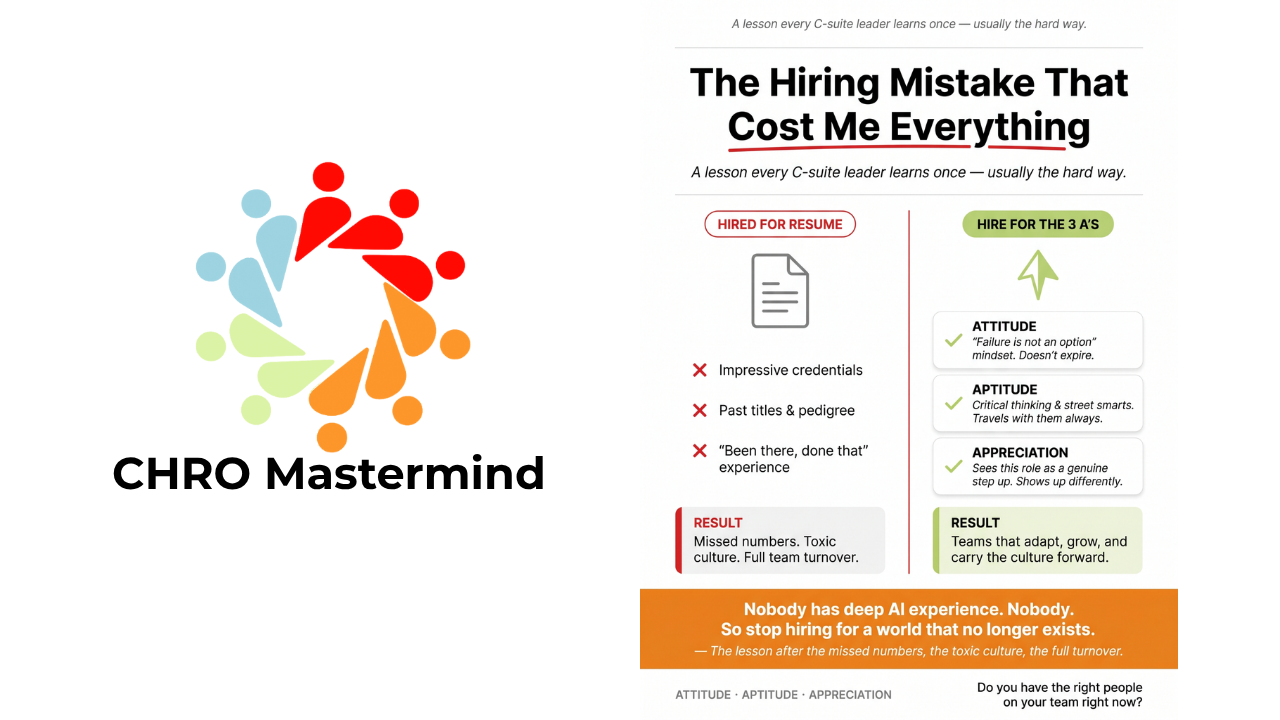
- Hire for attitude, aptitude, and appreciation
- Don’t keep average players around. Move fast
And I thought, yeah, that makes sense. We’re a fast-growth company. I just need people with strong resumes and experience.
So that’s what I did.
- I hired people with impressive resumes
- I prioritized experience over fit, every single time
- I kept players around longer than I should have because replacing them felt hard
It cost me.
I missed my numbers for the first time in my career.
I dreaded going into the office.
We had infighting, CYA behavior, and real toxicity spreading through the team.
Eventually, I had to turn over the entire group. All of it.
The advice I ignored the most
“Don’t hire for resume. Hire for attitude, aptitude, and appreciation.”
I thought I needed people who had been there and done that.
That a great resume meant a great hire.
That surrounding myself with people who understood the business better than I did was the safest move.
I was wrong.
What I saw the best operators do differently
The general managers I watched succeed across the country were not hiring the most decorated resumes.
They were hiring for:
- Fit
- A “failure is not an option” mindset
- People who saw the role as a real step up in their lives
They had been doing that from day one. And it worked.
What I finally understood
People with a real “failure is not an option” attitude will always figure it out.
Business changes. Technology changes. Markets shift.
But attitude doesn’t expire.
Aptitude, the kind built on critical thinking and street smarts, travels with someone no matter what the environment throws at them.
And appreciation?
When someone genuinely sees the opportunity you’re giving them as a step up, they show up differently. Every single day.
Why this matters even more now
Look at today.
Nobody has deep AI experience. Nobody.
So if you’re building your team around credentials and past titles, you’re optimizing for a world that no longer exists.
The people who will carry your organization forward are the ones who:
- Have the attitude to figure it out
- Have the aptitude to learn fast
- Have the appreciation to go all in
The part that took me longer to accept
Not every underperformer is the wrong hire.
Some are.
But some are operating without the coaching, clarity, or development they actually need to perform.
The real question isn’t always:
“Do I need to move this person out?”
Sometimes it’s:
“Have I actually set this person up to succeed?”
Both questions matter.
And knowing which one applies takes more than a gut reaction.
A simple way to think about your team
Most CHROs I talk to eventually realize every team member falls into one of three buckets:
- Right person, wrong environment
They have the attitude and aptitude, but they’re stuck in chaos, unclear expectations, or no support. - Right person, under-coached
They could perform at a higher level, but no one has slowed down long enough to develop them. - Wrong fit
The role, pace, or expectations don’t match how they operate.
If you skip this step and jump straight to replacing people, you’ll keep repeating the same cycle.
So here’s the real question
When you look at your team right now, do you actually know why each person is performing at the level they are?
Is it a fit issue?
A support issue?
Or something in between?
And once you’re clear on that… what’s your next move?
Because keeping the wrong person too long is a problem.
But so is replacing the right person when the system is what’s broken.
Where most CHROs get stuck
It’s not awareness.
It’s having the space to step back, diagnose it clearly, and act with confidence.
That’s where I see peer groups make the biggest difference.
They don’t take time. They make time.
They help you see patterns faster, pressure test your thinking, and move without second guessing every decision.
If you’re looking at your team differently after reading this, you’re not alone.
This is exactly the kind of problem CHROs work through together inside the Mastermind.
Request an invite to the Big CHRO Event the 2nd Friday each September.
For CHROs, CPOs and direct reports
