
How CHROs Can Walk Into High-Stakes Decisions With a Clear Point of View (Even Without Perfect Data)
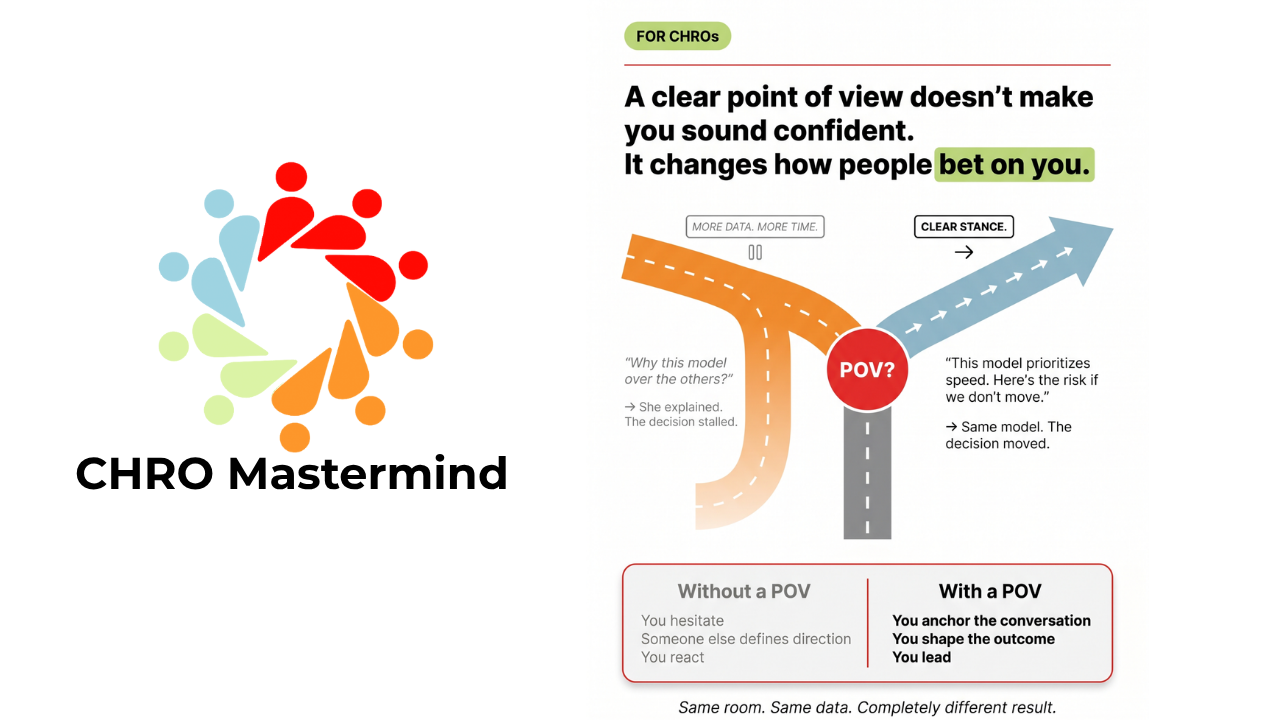
Most executives think better decisions come from better data.
They don’t.
They come from a clear point of view.
And at the CHRO level, that difference shows up fast.
Some leaders walk into a room and decisions accelerate. Others walk in and things stall. It’s rarely about intelligence or preparation.
It’s about clarity.
If you don’t have a clear stance, one of two things happens:
- You hesitate
- Someone else defines the direction
Either way, you’re reacting instead of shaping the outcome.
Why CHROs Struggle in High-Stakes Decision Moments
Question: Why do smart, experienced CHROs still get stuck in executive decisions?
Answer: They rely on data instead of forming a clear position ahead of time.
Most CHROs think:
- “I need more data”
- “I need more alignment”
- “I need more time”
That’s not the real issue.
The issue is walking into the room without a defined belief about what should happen and why.
Data should support your thinking. It should not replace it.
What Happens When You Don’t Have a Clear Point of View
Here’s how it plays out in real executive rooms.
Scenario 1: The HR Operating Model Decision
A CHRO presents a new HR operating model.
She has:
- Benchmarks
- Org design
- Defined roles
Everything looks solid.
Then the CEO asks:
“Why this model over the other options?”
She responds with information, not conviction.
- She explains instead of taking a position
- She hedges on tradeoffs
- She tries to keep everyone comfortable
What happens next?
- The CFO starts pulling apart cost
- The conversation drifts
- The decision stalls
Not because the model was wrong.
Because her thinking wasn’t anchored.
What Changed the Outcome
Before the next meeting, she pressure-tested her thinking.
Not for validation. For clarity.
She came back with:
“This model prioritizes speed over specialization. That’s what the business needs right now. Here’s the risk if we don’t move this way.”
Same model.
Different outcome.
The decision moved.
Scenario 2: AI Talent Strategy
A CEO asks:
“What’s our AI talent strategy?”
The CHRO isn’t ready.
So he says:
- “Let me gather more data”
- “I’ll come back with a plan”
Sounds reasonable.
But here’s what actually happens in the room:
- The CFO frames AI as a cost issue
- The CTO frames it as a technology issue
- The conversation moves forward
Without him.
The decision didn’t wait.
It just got made by someone else.
What Changed the Outcome
He came back with a clear position:
“We’re not starting with external hiring. We’re focusing on reskilling in two areas tied directly to revenue. If we get that wrong, we overspend and slow down execution.”
Now the conversation anchored around his framing.
Now the decision had direction.
How to Build a Clear Point of View Before the Meeting
Question: How do CHROs form a strong point of view without having all the data?
Answer: You pressure-test your thinking before you walk into the room.
Here’s a simple framework:
1. Define the priority
What matters most right now?
- Speed
- Cost
- Capability
- Risk
Pick one.
If you don’t, the room will pick for you.
2. Make the tradeoff explicit
Every decision has a tradeoff.
Say it clearly.
- “We’re prioritizing speed over specialization”
- “We’re prioritizing internal capability over external hiring”
This shows you’ve done the thinking.
3. State the risk of getting it wrong
This is where credibility shows up.
- What happens if you choose the wrong path?
- What does it cost the business?
Executives don’t just want recommendations. They want to understand risk.
4. Anchor the conversation early
Do this in the first few sentences.
If you don’t frame the conversation, someone else will.
Why a Clear Point of View Changes How Executives Respond to You
A clear point of view does more than help you sound confident.
It changes how people bet on you.
When you’re clear:
- Conversations move faster
- Decisions form around your thinking
- You become the person shaping direction
When you’re not:
- You get pulled into other people’s frames
- You spend time reacting
- Your influence drops, even if your ideas are right
The Pattern I See Across CHROs
After working with CHROs for over a decade, this shows up again and again.
It’s not a capability gap.
It’s a clarity gap.
The best CHROs don’t wait for perfect data.
They walk in with a position, backed by logic, and are willing to stand behind it.
That’s what accelerates decisions.
Final Takeaway
If you’re walking into a high-stakes decision, don’t spend all your time gathering more input.
Spend time getting clear on what you believe.
Because in executive rooms, the person with the clearest point of view usually shapes the outcome.
If you’re a CHRO working through a decision where the stakes are high and the path isn’t obvious, this is exactly the kind of conversation I spend my time on.
You can reach out directly or learn more here:
https://www.chropartners.com/
Request an invite to the Big CHRO Event the 2nd Friday each September.
For CHROs, CPOs and direct reports
