
“No Pure Managers” Sounds Efficient. It May Be a Leadership Trap.
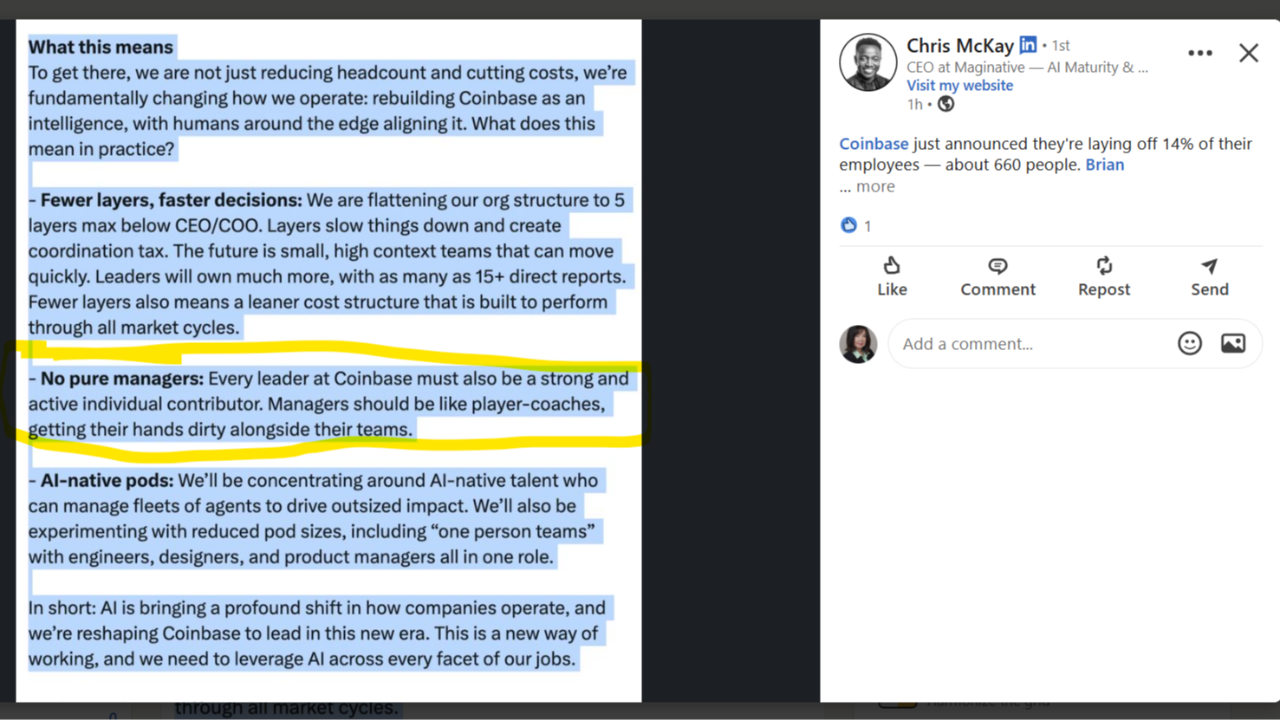
Coinbase recently shared that it is rebuilding the company around AI, fewer layers, faster decisions, and “no pure managers.”
One line really got my attention:
Every leader is expected to also be a strong and active individual contributor. Managers should be like player-coaches, getting their hands dirty alongside their teams.
I understand why this sounds appealing.
It sounds practical.
It sounds lean.
It sounds like the kind of thing a high-performance company should say.
But I disagree with it more than I can probably say politely.
What is the risk of “no pure managers”?
The risk is that the player part of the job almost always wins.
The client deadline wins.
The urgent deliverable wins.
The revenue pressure wins.
The manager’s own workload wins.
And coaching gets pushed to the side.
That is the part CEOs and CHROs need to be very careful about as they redesign organizations for the AI era.
Fewer layers may be the right move.
Faster decisions may be the right move.
AI-native teams may be the right move.
But if the answer is “no pure managers,” companies may be solving for speed while quietly weakening leadership.
Why does the player-coach model break down?
The player-coach model breaks down when leadership becomes something managers do after their “real work” is finished.
In theory, the model sounds good.
Managers stay close to the work.
They understand what the team is doing.
They have credibility because they are not removed from execution.
I agree with all of that.
Good managers need to understand the work.
They need to be close enough to know what great looks like.
They need credibility with the team.
But that is very different from carrying a full individual contributor load.
When managers are expected to produce like individual contributors and lead like full-time coaches, something gives.
And usually, the thing that gives is coaching.
What happens when leaders actually have time to lead?
I learned the value of this early in my career.
From 1995 to 2000, I worked at a company called The Parson Group. Our CEO, Dan Weinfurter, believed deeply in general managers who were coaches, not player-coaches.
Our titles were managing directors, but we essentially ran our own small business units.
And our job was clear:
- Find great talent
- Develop great talent
- Lead that talent
- Give feedback
- Shadow people
- Train them on the job
- Help them get better
That was the work.
Not in addition to a full individual contributor load.
Not squeezed in between client calls.
Not treated as a nice-to-have when everything else was done.
It was the job.
And this was not a slow, bloated company where people had unlimited time.
We were a startup.
When I joined, we were maybe around $5 million in revenue. By 2000, we were named the number one fastest-growing privately held company by Inc. Magazine.
I truly believe a big part of that growth came from the fact that our leaders had time to lead.
I spent the majority of my time coaching and developing people.
I spent another big part of my time finding great talent.
And I had time to think strategically about the business.
Was it still a lot of work?
Absolutely.
But it was the right work.
What gets lost when managers carry too much individual contributor work?
When managers carry too much individual contributor work, companies usually lose the work that creates long-term value.
That includes:
- Hiring well
- Coaching well
- Giving real feedback
- Developing future leaders
- Thinking strategically
- Building a team that can operate without constant rescue
The irony is that companies often choose the player-coach model because they think it is more efficient.
But if the team is underdeveloped, the work gets worse.
If the wrong people are hired, the cost shows up later.
If managers are too busy to coach, employees do not grow.
If employees do not grow, the company keeps depending on the same few overloaded leaders.
That is not efficiency.
That is a bottleneck with a better name.
What does this look like in real life?
I see leaders today who just do not have the opportunity to coach.
They have to be player-coaches.
And guess what?
The player part of the job will always win because the clients will always be more demanding than the employees.
I have seen this stunt growth.
I experienced it later in a more bootstrapped startup environment where I did not have the opportunity to just coach.
Client work took over.
Delivery took over.
The urgent work took over.
And the part that suffered was exactly the part that should never suffer: hiring the right team in the first place and developing them well once they were there.
It was a disaster, honestly.
Not because people were not working hard.
Everyone was working hard.
But the hiring of the right team in the first go-around suffered because I was spending so much time on client work.
And it was not sustainable.
Seventy-hour weeks are not sustainable.
And they do not make you a better leader.
They make you agitated.
They make you impatient.
They make working with your team feel like one more thing on top of an already full load.
That is when leadership starts to break down.
Is there a smarter version of the player-coach model?
Yes. If companies need leaders to stay close to the work, they should reduce the individual contributor load enough to protect coaching time.
I know some version of player-coach is unavoidable in certain companies, especially early-stage or resource-constrained businesses.
But even then, CEOs and CHROs need to be honest about the tradeoff.
If you want leaders to coach, you have to design the job so they actually have time to coach.
I saw this work at The Novo Group too.
We had consultants who were billable, but part of their job was also leading a team.
So we made sure their billable hour requirements were vastly reduced.
Why?
Because developing people was part of the job.
And it worked.
The quality of the work was strong.
Clients were happy.
There were fewer refund issues.
There were fewer collection issues.
And we had incredible gross margins as a result because the work was being done well the first time.
That is the business case for coaching.
Not because it sounds nice.
Not because employees like development.
Because better-led teams produce better work.
What should CEOs and CHROs think about in the AI era?
AI should give companies a chance to rethink how leaders spend their time, not just shrink teams and pile more work onto managers.
This is especially important now.
We are in a world where AI and automation should be helping streamline work.
That should create an opportunity to rethink how leaders spend their time.
But I worry that some companies will use AI to flatten, reduce layers, shrink teams, and simply ask managers to own more.
Some of that may be necessary.
Some of it may even be smart.
But if AI frees up leadership capacity, I do not think the automatic answer should be: give managers more individual contributor work.
Some of that time should go back into the work companies have underinvested in for years because everyone was too busy.
Hiring well.
Coaching well.
Giving real feedback.
Developing future leaders.
Thinking strategically.
Building teams that can operate without constant rescue.
That work does not become less important in an AI-enabled company.
It becomes more important.
Because the faster the company moves, the more expensive weak leadership becomes.
Questions to Ask Before You Redesign Manager Roles
Are player-coach managers always a bad idea?
No. Player-coach managers can work in early-stage or resource-constrained companies. The mistake is pretending they can carry a full individual contributor workload and still coach well.
What is the biggest risk of eliminating pure management roles?
The biggest risk is that coaching, hiring, feedback, and team development become secondary work. That weakens the company over time.
How should companies redesign manager roles in the AI era?
Companies should use AI and automation to remove low-value work, then protect time for managers to coach, develop talent, and think strategically.
AI should not automatically mean fewer layers and more work for every remaining manager.
What should CHROs watch for?
CHROs should watch for signs that managers are becoming bottlenecks:
- Slower development
- Weaker hiring
- More rescue work
- Burned-out leaders
- Teams that cannot operate without constant escalation
What is the business case for coaching?
Better-led teams produce better work.
Coaching improves quality, reduces rework, strengthens client outcomes, builds future leaders, and makes growth more sustainable.
The real question
So I will get off my soapbox now and ask you:
Have you experienced both?
Have you had the opportunity to just coach?
I know that may sound like a luxury today.
But if you are a CEO or CHRO designing your organization, I would really think about carving out time for leaders to actually lead.
Coaching may sound like a luxury.
But in my experience, it is often the thing that makes growth sustainable.
Request an invite to the Big CHRO Event the 2nd Friday each September.
For CHROs, CPOs and direct reports
