
How CHROs Build a Business Case the CEO Will Fund
You've probably sat through it. The same line item in the finance report, every month. Everyone in the room treats it as a fact of life. That's just the way it is.
At one company, that line item said they were collecting less than a quarter of what patients owed at the front desk. One CHRO asked why it was that way, and the answer turned out to be worth eight figures a year.
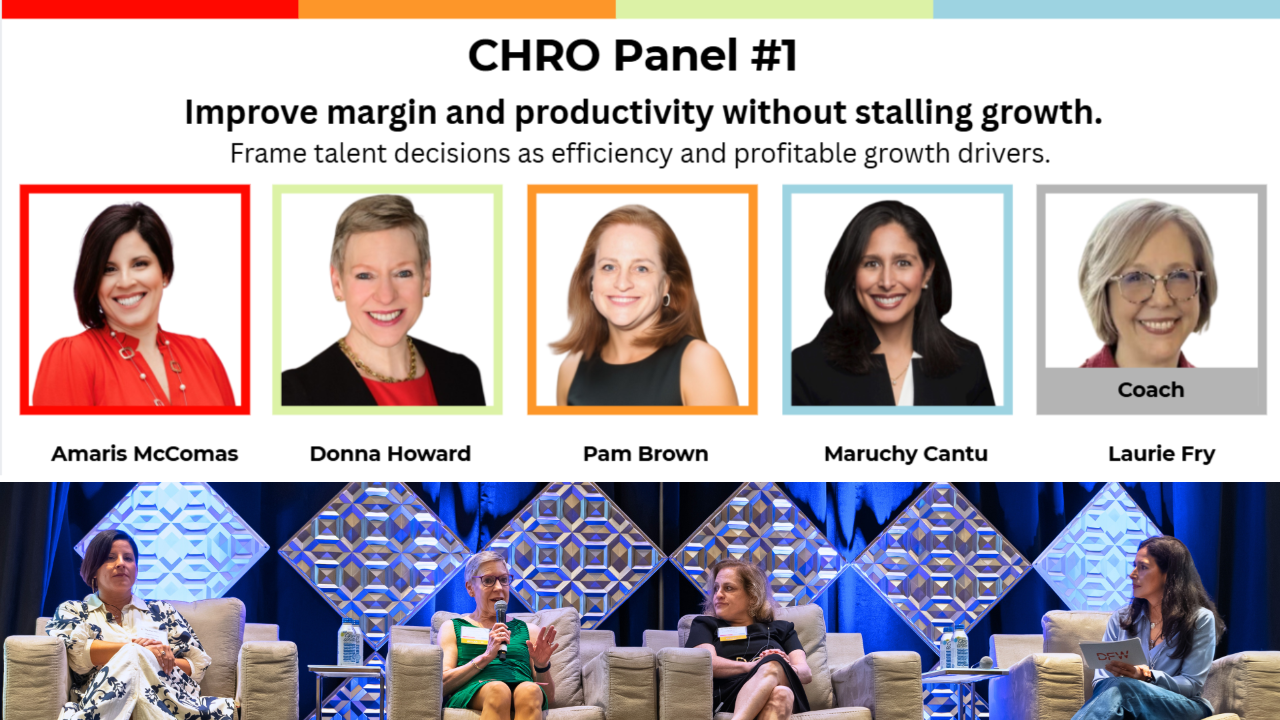
That story came out of the first panel at our 11th annual Big CHRO Event on September 11 in the Dallas, TX area. The panel was called "Improve margin and productivity without stalling growth." Three senior people leaders, three completely different businesses, and one line that tied it together:
"We're business people first. We just happen to specialize in people."
Names, companies, and identifying details are left out below, and dollar figures are written as $XX.XX million. These leaders were honest on stage because the room was safe. The lessons travel fine without the specifics.
How does a CHRO build a business case a CEO or CFO will actually fund?
Put the ask in the language the CEO already trusts. That usually means margin, cost of delivery, revenue, or retention tied to revenue, not fairness, culture, or engagement on their own.
I learned that the hard way. Years ago I sat across from a CEO and asked for bonuses for a delivery team that had never received an incentive check. He said no.
He wasn't the problem. He had been a CFO before he became CEO, and every important decision in his head ran through the P&L. I had walked in making the people case. Fairness, retention, culture. None of it was in the language he trusted.
So I went back. This time I didn't say one word about fairness. I told him our cost of delivery was too high because we were overpaying base salaries with no bonus lever to offset it. Then I asked him one question: if we hit our 40% gross margin target, do you really care how I divvy up the money?
Same ask. Same CEO. Completely different answer.
A good idea in the wrong language can sound like a bad investment. That's why, every year in our CHRO Mastermind Groups, we pick one competency to work on together, and this year it was speaking the language of the business. It's also why the panelists at The Big CHRO Event don't just show up and talk. They went through coaching sessions with our speaking coach, Aurora Gregory, prep calls, drafts, and rewrites until they could explain what they did in the language a CEO, a CFO, or a board would trust.
The gap is real across the profession. Research from The Josh Bersin Company, published in December 2025, found that only 3 in 10 CHROs have a business background, even though CHRO success relies on business acumen and cross-functional experience. And in Accenture's CEO research, almost 90% of CEOs said their CHRO should play a central role in long-term profitable growth, while fewer than half said they were creating the conditions for that to happen. The CHROs below didn't wait for the conditions. They built the case.
Where should a CHRO look for a business case?
Start with a number that's already in the finance report and ask why it is the way it is. The strongest cases aren't new programs. They're answers to a question nobody in the room was asking.
The first panelist was a CHRO at a healthcare services company that had grown by acquiring practices. The physicians kept their ownership, and their staff became company employees, which meant the physicians often still thought of those employees as theirs.
Every month, in the finance meeting, she saw the same line item. Collections at the time of service. What you collect from the patient while the patient is standing in front of you. They were collecting under 25% of it.
In her words, everyone in the room was fact based about it. That's the way it is. Nobody was asking why is it that way.
She was the newer kid on the block, so she asked. Finance didn't have an answer. Operations didn't have an answer. So she went to her trainers. One woman who had been there a long time gave her the real answer in one word.
Culture.
The physicians had a soft spot for patients they'd seen for years and didn't want to ask for the money. The front desk staff either didn't know how or were afraid to.
What she did:
- Built a training program and brought operations in from the start, on purpose. She tells her teams operations is their number one customer.
- Ran live online training, then had the people in the field who were already good at it tell their own stories, so employees heard it from peers.
- Sent trainers on-site to sit at the front desk and role play asking for the money.
- Showed each person their own numbers, added a small bonus tied to monthly collections, and turned the people who had resisted first into the new storytellers.
Four months later, the collection rate was up roughly 60%. Annualized, that was an additional $XX.XX million in revenue the business had been leaving at the front desk.
The physicians were convinced patients would walk. They lost none. Some patients said they'd been wondering when someone was going to ask.
And because the business model said you couldn't tell a physician what to do, none of this could be a directive. It had to be influence. When a physician was pressuring an employee not to ask for payment, she didn't say "they're not your employees, they're ours." She said, "our job is to give you the best support possible with the people we provide you. If she isn't doing what you think she should, let me know."
Same message. Completely different outcome.
Want to hear how she won over the physicians? CHROs, request the panel recording here and we'll send you the LMS log-in.
What should a CHRO do when their boss says not to take an idea to the CEO?
Shrink the ask into a pilot, get coaching on the pitch, and let the data carry it. A small, measurable test is much easier for a CEO to say yes to than a program.
The second panelist worked at a multi-site consumer business where frontline managers were player coaches. They served their own clients, they were the biggest individual revenue producers, and they were also responsible for recruiting, onboarding, and ramping the new service professionals underneath them. Guess which half got their attention.
Her proposal was to pay those managers a bonus to personally serve fewer clients.
Her boss told her not to take it to the CEO. He thought the CEO would look at her financial acumen differently. She took it anyway, as a pilot in two locations, with his coaching on the pitch. The CEO told her two wouldn't tell them enough, said test six, and gave her three times the money she asked for.
The data is what carried it. New service professionals who get training and development hours are 50% more likely to stay past 90 days. Stay past 90 days and they're likely to stay past two years. Stay past two years and they stay long term.
Ninety days in:
- Time to make an offer dropped 50%.
- Billable hours for the people being ramped went up.
- Retention of that group rose 25%.
- Every dollar of the investment came back, plus revenue on top. They're now running part two.
Two details worth stealing. Her industry calls those hours "non-billable." She deliberately calls them training and development hours. Words matter when you're asking someone to fund them.
And her AI method. Strip the personal information out of your data. Put it in whatever tool you use. Then tell it: "Ask me 10 questions, one at a time," so it understands what you're actually trying to answer. What she warned against is asking AI to make your case. It will light you up and build the case for you. Sometimes her answers to those 10 questions change her mind about what she wants to propose in the first place.
Want to see how she built that business case? Request the recording and watch her walk through it.
Why don't cost-cutting moves like offshoring deliver the margin leaders expect?
Because the assumptions underneath them go untested, and there's often no productivity baseline to measure against. Cost going down doesn't automatically mean margin going up.
The third panelist opened by warning the room that her story wasn't going to be a win. Her company delivers outsourced services to a specialized client base and was proud of an all domestic workforce. Clients loved it. The margin didn't. So they moved work offshore, on the assumption that cost goes down and margin goes up.
Here's what that assumption missed:
- Thirty days of overlap. Shareholders and the board wanted margin to move fast. It became double bubbles and triple bubbles, sometimes three times the people staying on to move the work. Her advice now: don't do that.
- Productivity gains would come quickly. They didn't. She says they're still working on it today.
- Busy meant productive. People were working long hours and the company was still bleeding. They'd never measured productivity, so nobody could explain the gap.
What it took to fix: a resource management model built with finance and operations, measuring productivity, quality, attrition, supply, and demand. Roughly 25 people, ninety days, around 30 iterations, and close to 20 measurements inside it. Along the way they found their contracts weren't tied to what clients actually needed, because sales wasn't talking to operations.
They rebuilt pay for performance on top of the model. In one group, the plan is 100% tied to client retention, client satisfaction, and quality of work, and only the top 25% get paid out. Behavior changed fast. She knows it worked because the business can't run without the model now. It isn't an HR program. It's embedded in how operations works day to day.
Her summary: the wrong assumptions cost them credibility with the board, put pressure on operations and employees, and that short-term push led to a way longer-term gap they've spent years filling.
Want to hear what she'd do differently? She tells the whole story, the parts that went wrong included, in the recording. Request it here.
How does a people leader show command of the whole business?
Tie every piece of HR work to a business outcome, and go see the business in person. The panel's closing lightning round came back to both.
- Refuse work that isn't tied to a business outcome. When you're in the room, you're a business leader who happens to have functional expertise, so the questions you ask should be much broader than HR. One panelist's test: when someone says "oh, I didn't know you were in HR," take it as the best compliment you'll get.
- Get your team out to the sites. One CHRO asked her HR team how many of them had visited an operating site. None. She gave them 30 days, with a disciplinary notice if they didn't go. All of them went. Her rule: you can't set goals if they don't start with the business first.
- Do the frontline work yourself. Another spent her own first 90 days in the field doing the work alongside the people who do it every day, because she couldn't have spoken the language of that business otherwise.
- Automate the transactional work. The most common reason a people leader never gets out into the business is that they're too busy, and that busyness is usually work a machine should be doing.
The pattern underneath all three
Every one of these stories started with a question, not a program. Why is that number so low? What happens if we pay managers to serve fewer clients themselves? Why are we busy and still bleeding?
And every one required going somewhere physical. The front desk. The floor where the service actually happens. The site. Not the dashboard, not the engagement survey, not a meeting.
I sit in a room every month with CHROs and next-in-line people leaders in our masterminds, and this is the pattern I keep seeing. The people who move the business aren't the ones with the best frameworks. They're the ones who went and looked.
A few quick answers
What's the fastest way to make an HR proposal sound like a business case?
Lead with the business number it moves, like margin, cost of delivery, revenue, or time to fill, and leave fairness and culture as supporting points, not the headline.
Should a CHRO pilot an idea before asking for full funding?
Often, yes. A small pilot with clear measures lowers the risk for the CEO. In one case at The Big CHRO Event, a two-location pilot request came back as six locations and three times the budget.
How should a CHRO use AI to build a business case?
Remove personal information from the data, then ask the AI to ask you 10 questions, one at a time, before it does anything else. Don't ask it to make your case, because it will tell you what you want to hear.
What's the biggest mistake in offshoring or restructuring for margin?
Moving work before you have a productivity baseline. Without one, you can't tell whether busy people are productive people, and the gap can take years to close.
How does HR earn credibility with the business?
By tying every piece of work to a business outcome and spending real time where the business happens. Credibility is built, not granted.
Want to see the panel?
This is exactly the kind of thing we work through at The Big CHRO Event, our flagship gathering of 100+ sitting CHROs in Dallas each September, and in the CHRO Mastermind Groups that run year-round. If you're a sitting CHRO and you want to watch how these three leaders built their cases, request the recording here and I'll get you the LMS log-in.
Request an invite to the Big CHRO Event the 2nd Friday each September.
For CHROs, CPOs and direct reports
