
How to Standardize People Practices Across Business Units
She had done this a hundred times. She knew the research, the mechanics, and exactly how to roll it out without hurting anybody's operation.
So she walked into the leadership meeting and started talking about PSL. Here's how we're going to do PSL. Here are the banks.
People started looking around the table at each other.
She kept going, because she was the expert in the room.
Eventually somebody got brave enough to ask: "Are we talking about pumpkin spice latte?"
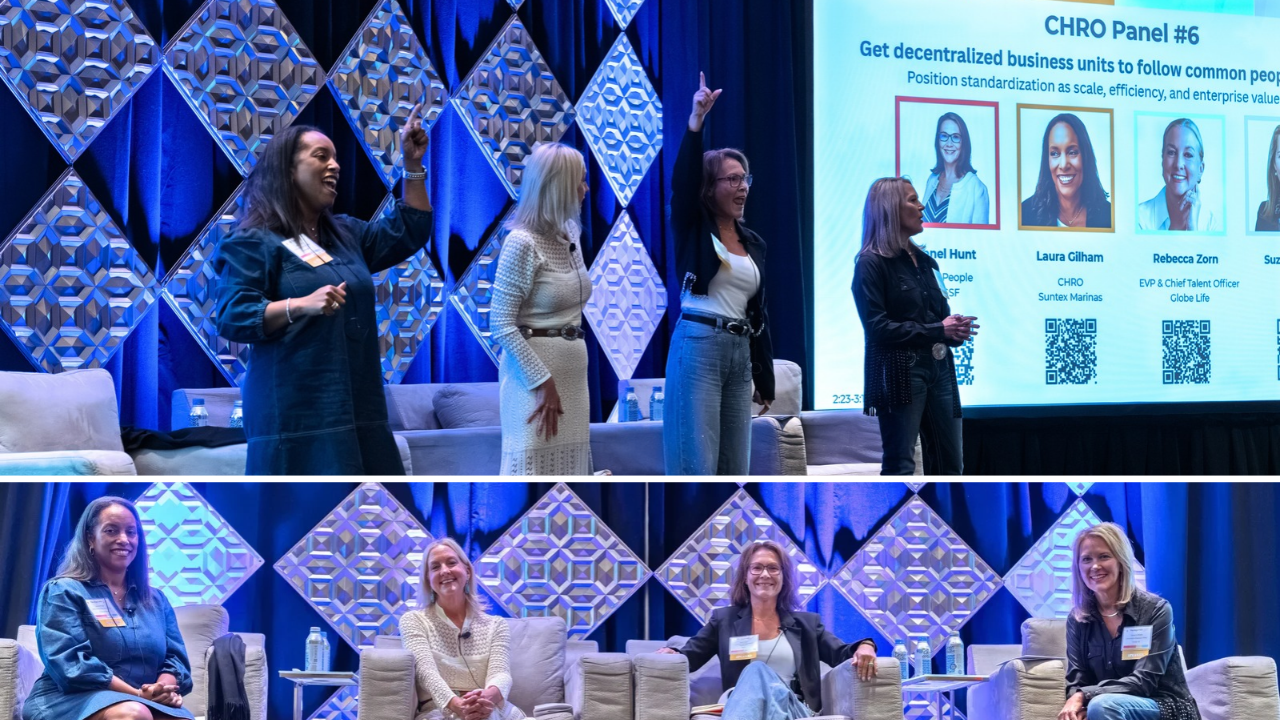
That was the sixth and final panel at our 11th annual Big CHRO Event on September 11 in the Dallas, TX area. The panel was called "Get decentralized business units to follow common people practices," and it closed the day, which was fitting, because it was the hour about the thing every other panel had circled. How do you get people who don't report to you to do what the business needs?
Names, companies, industries, and job titles are left out below. These leaders were specific on stage because the room was safe.
What people practices actually need to be standardized?
Anything that creates risk or inequity when it is inconsistent. What you can leave flexible is anything that drives engagement, efficiency, or operational improvement. That single rule of thumb replaces most of the debate.
One panelist, an attorney by training, gave that rule and then showed what it caught.
Her company holds five separate operating companies across more than forty states. Some of the workforce is unionized, some isn't. Each company has its own culture and its own expectations of the home office.
She was reviewing the numbers and noticed one division's legal fees were significantly higher than everyone else's. Not slightly higher. When she went digging, nearly all of that spend traced to one practice. That division was not involving HR in terminations at all. The others were.
So terminations got standardized. It sounds basic. It also brought that division's legal expenses down.
The same logic ran through hiring systems, because the subsidiary companies could not each afford their own. She has since put everyone on a single platform where the same steps are required of everyone.
Note what the rule does not say. It does not say standardize because consistency is tidy.
Is standardization the goal?
No. Consistency is. Another panelist said this outright, and she said it as someone who had gone too far in the other direction.
"Standardization is not the objective. You want enough consistency so that you can move the business forward, and move it forward quickly."
Her company is currently walking back some of its own work, because they over-engineered the standardization the first time and are now asking whether parts of it were ever the right call. She still has people telling her that if it is not broken, do not fix it.
Where inconsistency genuinely costs you is friction. Friction slows collaboration, and slow collaboration slows growth and innovation. That is the business case, and it is narrower than most HR functions assume.
Where do you start in a decentralized company?
With shared language, not policy. It is the cheapest work available and it is the foundation everything else sits on.
One panelist joined her company about eight years ago. Three divisions, three division presidents, each running what amounted to its own company down to separate tax IDs. A new CEO brought her in with a mandate to get the whole thing operating as one organization while doing roughly an acquisition a year.
What she learned fast is worth quoting in full:
Every people practice they tried to put in place was a proxy for something else. It was a proxy for how are we going to run this thing as one company.
That is why those leadership meetings went the way they did. Nobody was arguing about the policy.
So they stopped working on policy and started on the smallest possible thing. What do we call our employees? Are they team members? Do we have consultants, or contractors? They changed "corporate" to "home office."
Eight years later they are down to one division, having done many acquisitions and divested two.
Want to hear how she got three divisions operating as one? CHROs, request the panel recording and we'll send you the LMS log-in: https://www.chropartners.com/recording-request
Why do business unit leaders resist standardization?
Often because they do not understand what you are asking for, not because they disagree with it. The pumpkin spice latte story is the cleanest example anyone will ever give you.
She was right about the policy. She had the research, the mechanics, the rollout plan. And she lost the room in the first thirty seconds because she used three letters that meant something entirely different to everyone else at that table.
Her own diagnosis afterward was not that they were resistant:
"Going in with an expert mindset is one of the easiest ways to get someone to resist."
She said she would resist it herself. Her alternative is to walk in like a pioneer rather than an expert. Be genuinely curious about what the business needs, what is on their scorecard, and what they do better than you do.
And she made it structural rather than a personal resolution. She is putting her whole team through an executive development journey so they stop speaking HR, learn to read a P&L, shadow the operation, and show up as partners rather than police.
How do you get buy-in from leaders who don't report to you?
Translate the ask into their scorecard before the meeting, hold the destination but negotiate the route, and bring people in while the plan is still being built rather than when it is finished.
Three specific moves came out of that hour.
Start with the with-them, not the with-me. One panelist opens by asking where they are trying to go and what they are trying to achieve, then shows how her ask helps them get there. Saves time, saves money, keeps them out of legal trouble, moves their engagement score. Her preparation step is the practical part: look at their scorecard before you walk in.
Give away the sequence, keep the destination. Her version: I am at A and I need to get to Z. There are several ways to get to Z, so make it a conversation. She will propose A, B, C, D, and a leader will tell her that C lands three days before the Fourth of July and it is not happening. So they go A, B, J, C, and still land at Z. Most leaders are resisting the sequence, not the destination.
Bring them into the kitchen. The compliance-minded panelist builds a business case and, as she puts it, a cake. "I'm bringing everybody into the kitchen while we're building the cake." At the end she wants a dessert. Maybe three layers, maybe seven. It does not much matter which, so she asks. Are you looking for seven or three? Is there coconut? Are we allergic to coconut? Her success comes when people are in at the inception.
She was firm that buy-in alone is not enough. Without the data and the numbers she will fail even with the adoption. You need both.
What does "so that" mean in an HR business case?
It is the answer to the question a skeptical executive is silently asking. "So what?" gets answered by "so that." It forces every HR proposal to name the business outcome it enables rather than the HR outcome it produces.
One panelist started requiring this of her own team about two years ago, and it changed what reaches the business at all.
We all have our best and brightest programs. This one will do this, it will save us that. Her response: bring me a business case. If it does not pass her muster, it does not get to the business partners.
Her team did not love her for a while. She kept sending things back. I need the why. I need the so that. You are not delivering it with the data the business is going to ask for. Then they would bring it back with the support, and it would land.
Our moderator had the same lesson from earlier in her career. She would spend hours on a slide, bring it to her leader, and the leader would look at it and say, "All right, so what?" That was the entire coaching.
Her example of the difference: I cannot ask you to send me your best people and increase your travel budget because you need good leaders. It is that your leader needs to develop so that you can grow.
One detail that makes this work rather than just making it harder. She pairs the demand with somewhere safe to practice, running quarterly business reviews inside HR where her team presents on a four blocker before anyone stands in front of an executive.
What is a change champion, and who should be on it?
A group drawn from across the business that carries a change out to the field and brings resistance back in. The counterintuitive part is that you want the skeptics on it, not just the supporters.
In her words, sometimes the champions are the biggest resistors. The people who are going to poke holes in anything you roll out.
"Sometimes it's my business partner saying, I need that person, because they're going to be the biggest troublemaker and I've got to get them on the team now."
She sends them out with an assignment. Take this back to your teams and get me all the holes. Bring me what is going to come at me. They carry the good news back too, which she says matters as much.
Why it works in a decentralized company is arithmetic. Her HR business partner team is lean. They cannot be in every room, at every level, in every conversation. The champions extend the influencing reach into places HR is not.
They still hit road bumps. They hit fewer.
Two details worth having. The group is a development assignment sitting in plain sight, so put a high-potential person on one and let them learn to sell internally. And her next one is an AI Champions Round Table, built on nominations rather than an open invitation.
A one-person version of the same idea came from another panelist. Before rolling out mental health days she called her head of operations in one region and said tell me what I have missed, shoot holes in this, challenge me. At rollout she did not get "you're giving them two more days off," because that conversation had already happened.
Pre-sell it. You would never walk into a compensation committee meeting cold.
Want to hear how she runs the change champion group? Request the recording: https://www.chropartners.com/recording-request
How long does adoption actually take?
Longer than the rollout plan says. Nine months into a new system, one panelist's change champions still meet monthly and she still presents new facets of it, because the return she promised when she asked for the tool depends on continued adoption.
Another gave the reason you cannot let it lapse. If you let it go dormant, people stop using the muscle. You have to keep it top of mind long enough for the muscle to form.
And a third named the condition most people leaders are actually working in: constant change fatigue. Acquisitions, divestitures, an entire new tech stack, and she would like to change that again. There is an open debate on her team about whether people simply need to be adaptable and roll with it, or whether the fatigue is a signal worth reading. She does not get a long runway on any one change, because tomorrow something else changes.
The research says the fatigue is real and measurable. Writing in Harvard Business Review, Cian O Morain and Peter Aykens of Gartner reported that the average employee went through 10 planned enterprise changes in 2022, up from two in 2016, and that over the same period employees' willingness to support enterprise change fell from 74 percent to 43 percent. Their recommendations, notably, include building deliberate rest periods into transformation timelines and involving employees in the planning rather than the announcement.
Which is an outside endorsement of the change champion model, and a caution about stacking initiatives because each one individually looks reasonable.
How do you hold leaders accountable without becoming the police?
Build the follow-up into a cadence, use the accountability lever your culture actually responds to, and then train managers to own it so the function is not the enforcement arm.
Three mechanisms came up, and then a disagreement that is the most useful part of the section.
Programmatic check-ins. A set cadence for HR partners, with a heavier version for new hires at 30, 60, 90, and 120 days. In a decentralized company that has a second purpose. Someone may be the only person from the organization at their location, in their state, with no other leaders nearby, and a scheduled check-in is what keeps them from feeling like they are on an island.
Competition. They launched a culture survey this week and are running a contest alongside it, with people ready to pie someone in the face if the locations do what they have been asked to do. Better suited to short rollouts than long ones.
Knowing your own culture. On her leadership team the lever is mild public shame. When reviews are due she walks into the leadership meeting and names who has not finished. She warns the people who do not like it: for the record, if you do not finish, you are getting mentioned Monday morning.
Then another panelist pushed back.
"I don't think it can always be us holding people accountable. We shouldn't be the police."
Her company has many new managers who never got trained. Her answer is to teach them to operate a little in the gray, which she acknowledged makes some HR leaders cringe, because a policy cannot hold anyone accountable. Only a person can.
Train the managers to be the accountability partner instead of doing it for them. Otherwise you have built a system that only works while you are watching it.
How do you integrate an acquisition without destroying what made it work?
Move fast on the non-negotiables and ask, in the other direction, what the acquired company does better than you do. You bought them for a reason, and centralizing everything is how that reason gets erased.
On speed, all three panelists agreed: rip the Band-Aid at one moment rather than slowly. One of them said HR had always gone in on day one, and her IT team eventually noticed that HR was not dealing with the ongoing pain everyone else had, because everyone else was still running five accounting systems. Now they all go in on day one. She did not win that argument by arguing. She kept doing it right until a peer function copied her.
On what to protect, this was the passage of the hour:
"You acquired them for a reason. There was something very special about that organization. If you only think about it from we're centralizing the heck out of you and making you do some HR processes, you're going to lose what's special, and that's a real shame."
So she asks the reverse question: what do you do better than we do, that we should all be doing together now?
Then she reminds them of their own reason for joining. You wanted the larger organization because it gives you the structure and foundation to run your strategy and your special sauce.
Another panelist reached back to Stephen Covey for the same point. Seek first to understand. Ask what made their organization special, because diligence covered the financial side and almost certainly missed this, then help them carry it into their day-to-day so it does not feel like the big house arrived and took everything.
Can peer pressure do the work for you?
Yes, and it is more effective than anything HR says directly. Usually one business unit is already doing what you need everyone to do, and hearing it from a peer carries more weight than hearing it from the home office.
"I help them sell each other on the centralization."
At her strategic offsite this month the room was set in a U with one end capped, which made a ring. She joked about putting everyone in the middle with boxing gloves.
What happened was better. She watched them work on each other. They sold each other on why the thing she wanted done was right, and on what was in it for them.
Her summary: it is not just what I say, and it is not only the business case I bring. Someone else is living the result, and that experience does the convincing.
The other panelists added the qualifier that keeps this honest. More often than not you are the one who puts those two people in the same room. The peer persuades. You make the introduction.
What improves first when people practices become consistent?
Managerial effectiveness, then financial results, then strategic goals, in that order. The first visible signal is in the immediate managers, whether that shows up in engagement scores, retention, or something else.
Her example is the strongest argument for governance from the whole day, and it is the opposite of what people expect.
Different groups were doing wildly different things on social media with no common policy. She got everyone onto one.
Then something she had not predicted happened. People stopped asking for forgiveness and started asking for permission. The managers got excited, because having rules meant they suddenly had freedom to work inside them.
"Give me the lines to color in. And once we gave them the lines to color in, then they felt able to make that beautiful picture."
The business saw increases in places it had not before, from groups that had been off on their own without results.
That is the case for standardization stated correctly. Not control. Permission.
One counterweight from another panelist, offered with a grin about having gone to the dark side. When her attorney brings a recommendation, she asks what risk would actually materialize if they did not do it his way. Her senior employment counsel reports to her, so she is often the one arguing that not everything can be tied in a neat bow.
Sometimes the business is right. Risk tolerance is a business decision, and the job is to give leaders the range rather than the answer.
The pattern underneath all of it
The panel converged on one piece of closing advice, and two of the three gave the same answer: what is in it for them. One put it better than I can. It is so that the mirror turns away from me and onto them.
The third gave the one I will keep. Stand on your head. Look at it from a different perspective, not just your own lens. She tells that to every new hire class.
Which is the pumpkin spice latte story again. Everything went wrong at the moment the smartest person in the room spoke from her own lens instead of theirs.
Across all six panels at the event, the same move kept surfacing. Understand the business well enough to talk about your work in its language, then own the whole problem instead of your slice of it. In a decentralized company you just have to do it without any authority to fall back on, which is why the leaders who are good at it talk about influence as a muscle rather than a skill.
A few quick answers
What should be standardized across business units? Anything that creates risk or inequity when it is inconsistent. Terminations, compliance-sensitive procedures, and the systems of record are the usual candidates. Leave flexible what drives engagement, efficiency, or local operational improvement.
Is standardization the same as consistency? No, and the difference matters. The goal is enough consistency to move the business quickly. Standardization pursued for its own sake gets over-engineered and then has to be walked back.
Where should a CHRO start in a decentralized company? With shared language rather than policy. Agreeing on what you call employees, roles, and the home office costs nothing and is the foundation the rest sits on.
Why do leaders resist HR initiatives? Frequently because they do not understand the ask. Acronyms and HR framing read as noise. Walking in as the expert rather than as someone curious about their business is one of the fastest ways to create resistance.
Who should be on a change champion team? The skeptics as well as the supporters. The person most likely to poke holes in your rollout is the person you most want finding those holes before launch, and their buy-in carries weight with their peers.
How long does adoption take? Plan for the rollout to be the beginning. Nine months into a new system, one panelist's change champions were still meeting monthly, because sustained adoption is what produces the return she promised.
Is change fatigue real? The data says yes. Gartner researchers reported in Harvard Business Review that the average employee faced 10 planned enterprise changes in 2022 versus two in 2016, while willingness to support enterprise change fell from 74 percent to 43 percent.
How do you integrate an acquisition without losing what made it good? Be fast and clear on the non-negotiables, and ask what they do better than you do. You bought them for a reason, and centralizing everything is how that reason disappears.
Want to see the panel?
This is exactly the kind of thing we work through at The Big CHRO Event, our flagship gathering of 100+ sitting CHROs in Dallas each September, and in the CHRO Mastermind Groups that run year-round. If you're a sitting CHRO working across business units that do not report to you, request the recording here and I'll get you the LMS log-in: https://www.chropartners.com/recording-request
Request an invite to the Big CHRO Event the 2nd Friday each September.
For CHROs, CPOs and direct reports
