
How CHROs Take a Business Problem to the CEO
She was the only one from her team in the room.
The agenda was running early, the executives were ready, and the person who was supposed to lead the pitch hadn't arrived. So they turned to her and said go ahead.
She got through it. Then the CEO looked at her and asked whether she was proposing something that wasn't a requirement, only a recommendation, that would add millions in cost, with no way to self-fund it.
Crickets.
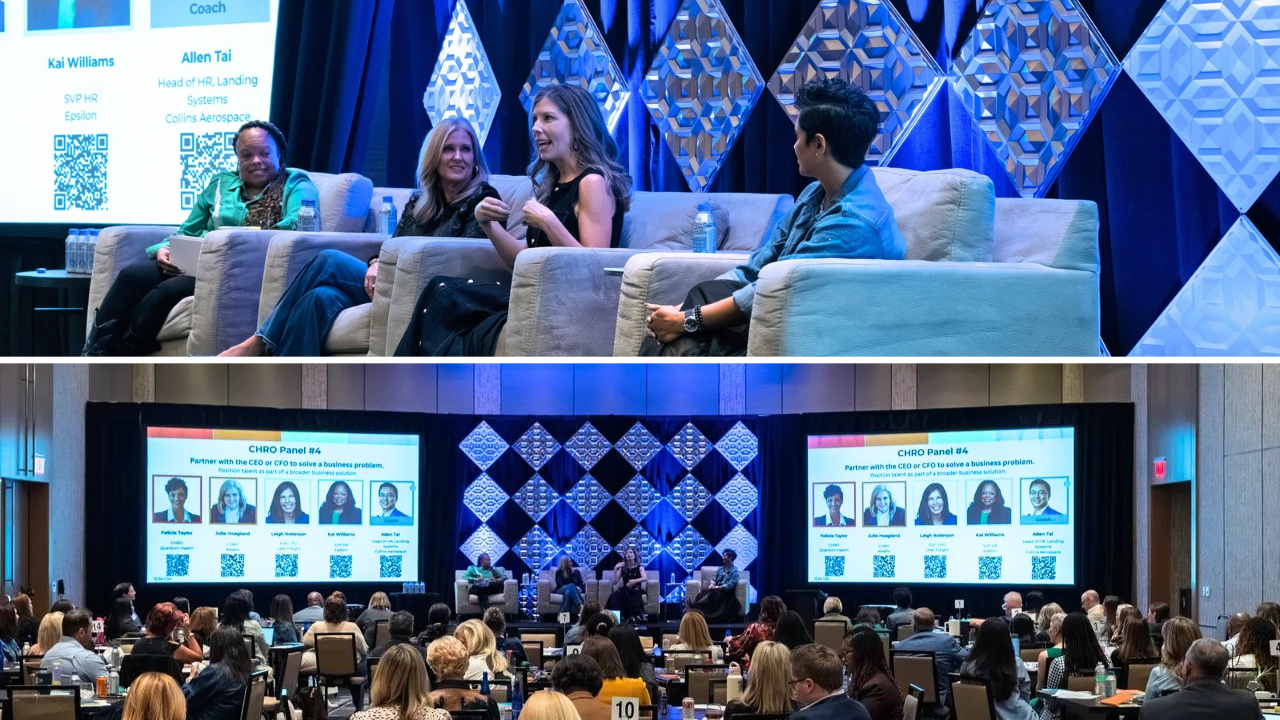
That story came out of the fourth panel at our 11th annual Big CHRO Event on September 11 in the Dallas, TX area. The panel was called "Partner with the CEO or CFO to solve a business problem," and it was the hour where everybody admitted what they got wrong before anyone said what they got right.
Names, companies, industries, and job titles are left out below. These leaders were specific on stage because the room was safe.
What do CEOs and CFOs actually want when HR brings them a proposal?
They want the business case, and they want to know it's been stress tested by the person presenting it. The fastest way to lose the room is to bring forward a proposal you haven't personally poked holes in.
Back to that boardroom. Her company ran a business decision week. Once a month every senior executive flew in and sat in a room for four days while teams rotated through in 45 minute slots. You walk in with three slides and forty in backup, because a decision gets made before you walk out.
The initiative wasn't hers. Her team owned one slice of it, the people piece: work schedules, shift schedules, overtime, cost, hiring plans. The broader effort came from another function, and it was a recommendation, not a requirement.
Here's the part that matters. She had already looked at it and thought the return wasn't there. She was surprised by the business case. She wondered how it was going to go.
She didn't push on it, because it wasn't her section.
So when the room ran early and she was the only one there, she pitched a proposal she privately didn't believe in, and got the one question nobody on the team had answered.
Her takeaway, from fifteen years ago, still in the present tense:
We are businesspeople first. We are HR people second. We own the initiative. We own the problem.
And the operational half of it:
If you see something that doesn't seem right, it's your job to poke holes in that business case up front. Don't assume the person with more expertise or more years is going to own it. If you're connected to it, you own all of it.
The instinct that gets people burned is the opposite one. You spot the soft place in someone else's numbers, you assume they've thought about it harder than you have, and you stay in your lane. Then the meeting runs early.
How do you build the case for spending that isn't in the budget?
Diagnose the real cause, quantify the cost of doing nothing, align with the CEO on it being a business problem before you ask anyone for money, then solve it and measure the result a year later.
One panelist put that in four words she uses every time: diagnose, quantify, align, solve. Here's how it played out when she had to ask her CEO and CFO for several hundred thousand dollars that wasn't in anyone's budget.
Diagnose. The easy read on her turnover problem was compensation. People are leaving, so pay them more. The data pointed that way. But digging in, the real cause was that the company had grown fast without a job architecture or a compensation philosophy, so new hires were coming in above tenured employees. And in that business, with very few documented processes, institutional knowledge was the actual asset. Every time it walked out the door it got more expensive to replace.
Quantify. This is the step most people skip. She worked out what a single departure cost, multiplied it by how many people they'd lost, and landed in the millions.
That let her reframe the ask completely. Instead of HR needs this money, it became: this is costing us millions a year, and I have a problem I can solve for a fraction of that today.
Align. She went to the CEO first, deliberately, because the issue was bigger than the dollar figure. She walked in with a problem statement rather than a request and asked one question: do we agree that we have a business problem here?
Not an HR problem. A business problem. Then she laid out the cost of doing nothing.
By the time she reached the CFO's office, it wasn't a sale. She had alignment and a number, so the conversation was about protecting the business rather than funding a department.
She got the money.
Solve, and close the loop. A year later, turnover attributed to compensation was down 20%.
That last step is what compounds. Diagnose it, quantify it, align on it, fix it, then measure it, and you earn the credibility that buys you a hearing on the next thing.
Want to hear how she framed the ask? CHROs, request the panel recording and we'll send you the LMS log-in: https://www.chropartners.com/recording-request
How should a CHRO disagree with the CEO?
Go back to the criteria everyone already agreed on, show the options against them, tell the CEO up front that your view is unpopular and that you're willing to be overridden, and then make the case.
The mental model another panelist uses: start with the business problem. Define the criteria, what you're actually optimizing for, usually some mix of speed, cost, and risk plus whatever else matters here, like business continuity or employee flexibility. Lay the options against the criteria. Then have the courage to push back if the business is about to pick the wrong one.
Her situation was a genuinely complicated compensation design, complex enough that their own bankers said they'd never seen anything like it. She was in a room with the CFO and the chief legal officer, needing to lock the design, moving fast.
They told her: we need to do it this way, this is what the CEO wants.
She's visual, so she draws the options as a red, yellow, green heat map against the agreed criteria. Three options on the page. By her own map, the one they were about to choose wasn't the right one.
They pushed back. This is what the CEO wants, and we're running out of time.
"Yeah, I know. But I don't think that's the right thing to do."
So she told them she was going to take it to the CEO. Not behind them. In front of them, with a heads up, which is the detail that kept it from becoming a political fight.
Then, to the CEO:
"I know what you've asked for. I know you think you want this. What I'm about to say is an unpopular opinion. I'm willing to be overridden. But I really don't think we should go this way, and here's why."
Then the criteria, the trade-offs, and the risks.
The CEO's answer: you're right, this isn't what I want, but it makes sense, it's the right outcome, let's go.
Look at what that opener is doing. She names what the CEO asked for, so it's clear she listened. She flags that her view is unpopular, so nobody discovers it mid-sentence. She concedes the decision isn't hers before she argues, which takes the threat out of it. Only then does she make the case.
That isn't bravery. It's construction.
Two caveats from the same panelist, both worth keeping. The way you push back the first time has to be different from the fortieth, because you're building credibility before you're spending it. And she's been overruled plenty, which she describes as completely fine. Disagree and commit.
She also named why she does it. She has often been the only one in the room. The only woman, the only person of her generation, the only one with her viewpoint. On one leadership team, the only person oriented toward people rather than results. What changed her was realizing that if she didn't put that perspective in the room, it wasn't going to be there at all.
Want to hear the full exchange? Request the recording: https://www.chropartners.com/recording-request
How do you get an executive team that isn't aligned to align?
Force them to prepare against the same questions and the same data before they walk into the room, and give unresolved topics a formal debate window before anyone communicates anything downward.
A third panelist framed her partnership with her CEO as three Ts.
Translate. Not our engagement score has gone down. Our engagement score has gone down in this area, and we're at risk of missing the number. Same fact, translated into the thing the business is worried about.
Trust. You earn your place by knowing the whole business, including the P&L. The compliment she treasures most from her executive peers is that they think of her as a leader, not as the HR leader.
Together. She doesn't bring her CEO problems. She focuses on what he's trying to accomplish and partners on it. How does she know what that is? She asks him, constantly. Her one-on-ones are mostly tell me what's going on.
Then the story. She joined a month after a new CEO, into a dysfunctional executive team, and the two of them spent about eighteen months rebuilding it. It held for four years. Then three executives left, three arrived, two through an acquisition, and the team was high energy and running in completely different directions.
When an executive team isn't aligned, everybody below them can see it. One leader says this, another says that, and their people compare notes.
The research says this is more common than leaders think. Writing in Harvard Business Review, Vikas Mittal, Alessandro Piazza, and Ashwin Malshe reported that actual strategic alignment across employees, managers, and executives ran two to three times lower than the alignment those same people believed they had. So the gap isn't usually that teams know they disagree. It's that they're confident they agree.
What she and her CEO built was a decision making framework for their next offsite. Nine questions. Five business topics. Three weeks of preparation before anyone walked in, with pre-reads running twelve to fifteen pages.
The point was to force the team to slow down and gather data before defending a position.
It worked in the way that counts. People arrived with the same information instead of the same opinions. They listened. Several changed their minds, including her, and the group landed somewhere different from where it started.
They added one more rule, and this is the one I'd steal first. If a topic isn't fully settled, it goes into a two week debate period before anybody communicates anything to their teams. That single rule kills most visible misalignment, because misalignment downstream is usually just leaders broadcasting a decision that hasn't finished being made.
One aside worth hearing. She didn't facilitate that offsite. In HR we assume our job is to facilitate. She was a participant, because she's part of the team.
What are the most common mistakes HR leaders make with their C-suite?
All four people on that stage led with a failure, and the failures rhymed.
- Owning your slice instead of the whole problem. The boardroom story above. She had doubts about a business case and didn't raise them, because that part belonged to another function.
- Analyzing your peers without talking to them. One panelist was asked by her CEO to assess the executive team. She pulled the data, built a scorecard, and took it straight to the CEO without speaking to a single one of them. Her words: "I snitched on my peers." The CEO's response was one question. Have you validated this? What have they said? When she did go to the executives, some of her read was right, but she got context the data didn't hold, including turnover that had been deliberate. It ended up building trust rather than breaking it, but only because she went back.
- Pitching what matters to HR before you understand what matters to the business. Another panelist could see her fast-growing company needed job architecture and career pathing. People were asking for it. The CFO and COO weren't interested, because she hadn't looked at the business first or understood her stakeholders. Years later she learned those two were wired as skeptics who would hunt for the pitfalls in anything. Once she knew that, she walked in leading with everything that could go wrong, and earned their trust that way.
- Lining up every stakeholder except the one who holds the money. Our moderator's own story. A private equity owned business, two acquisitions, hiring at scale, no real systems. She built the case for a new HR platform and lined up the CEO and the CFO. She didn't line up the private equity firm. It went over, in her words, like a lead balloon. Her diagnosis: they speak in P&L and she wasn't speaking in P&L. Her CFO gave her a team, made her practice, and the second attempt landed.
Two of those four were fixed by a senior person deciding to invest in the leader rather than write them off. One of them asked for an executive coach and got six months of it, which she called the most intense experience of her career. Her line about that is the one I keep repeating:
"In HR, we're always pouring into everyone else. We don't ask for things for ourselves."
Want to hear all four in their own words? Request the recording: https://www.chropartners.com/recording-request
The pattern underneath all of it
Four different failures, and they were the same failure. Each person had stayed inside their piece of the problem.
And the three frameworks they built afterward, diagnose quantify align solve, criteria choices courage, translate trust together, are three routes to the same place. Stop showing up with your part. Show up with the whole thing.
Our moderator opened the hour by getting the room on its feet for three prompts: stand if you've pushed past a quick fix to the actual root cause, stay up if you've been the only contrary opinion in the room, stay up if you've built something with your CEO so that by the end they owned it.
Everyone was still standing. Those aren't three skills. They're one, and it's the habit of owning the whole business problem instead of the HR slice of it.
A few quick answers
What's the first thing to do before asking for unbudgeted money? Quantify the cost of doing nothing. An ask framed as "this is costing us millions a year and here's what it costs to fix" is a different conversation from "HR needs this money."
Should you align with the CEO or the CFO first? It depends on what you're solving. One panelist chose the CEO first, deliberately, because her issue touched customer outcomes as well as cost. By the time she reached the CFO she had alignment and a number, so it wasn't a sale.
How do you disagree with your CEO without damaging the relationship? Give the other executives a heads up first rather than going around them, name that your opinion is unpopular, say plainly that you're willing to be overridden, and argue from criteria the group already agreed on.
What do you do when you doubt someone else's business case? Raise it early, while it's still cheap. If you're connected to an initiative, you own all of it, including the parts another function built.
How do you fix an executive team that keeps sending mixed messages? Make them prepare against the same questions and the same data before the meeting, and put unsettled topics into a formal debate period before anyone communicates downward.
Is it worth getting an executive coach as a CHRO? Every other executive on your team probably has one. HR leaders are the least likely to ask for that investment in themselves, and the panelist who did called it career-changing.
Want to see the panel?
This is exactly the kind of thing we work through at The Big CHRO Event, our flagship gathering of 100+ sitting CHROs in Dallas each September, and in the CHRO Mastermind Groups that run year-round. If you're a sitting CHRO and you want to watch how these leaders took business problems to their CEOs, request the recording here and I'll get you the LMS log-in: https://www.chropartners.com/recording-request
Request an invite to the Big CHRO Event the 2nd Friday each September.
For CHROs, CPOs and direct reports
