
How CHROs Connect Culture Work to Business Results
One mistake cost a company 40% of its margin.
It wasn't a technical failure. It was a manager who wouldn't say out loud that he was out of his depth, at a company whose stated values were communication and accountability.
He wasn't a bad employee. He was one of the most valuable people they had, and that was the whole problem.
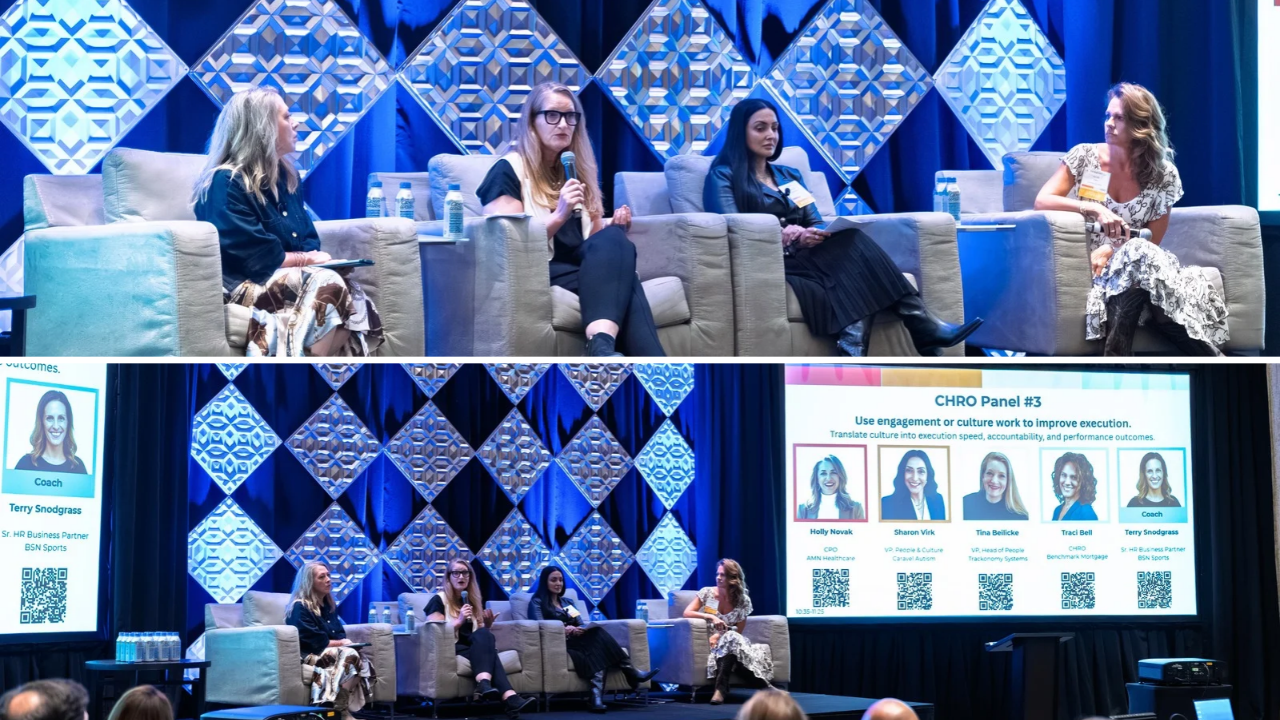
That story opened the third panel at our 11th annual Big CHRO Event on September 11 in the Dallas, TX area. The panel was called "Use engagement or culture work to improve execution," and it was the hour where culture stopped being a soft topic.
Names, companies, industries, and job titles are left out below. These leaders were specific on stage because the room was safe.
Does culture actually drive business results, or is it a soft metric?
It's a business driver, and the reason it doesn't get treated like one is that most of us measure what HR does instead of what culture enables.
That's how one panelist put it, and she's been on a long personal mission to fix it. Culture has historically been treated as discretionary, managed off to the side of the business, an HR thing in the periphery. Then we measure it, stop at leading indicators like listening, and never connect those to the outcomes that matter.
"Culture is either managed intentionally, or it manages you."
She pointed to a finding from Josh Bersin: companies that integrate people data with operational and business data are roughly three times more likely to exceed their financial goals, and three times more likely to achieve high productivity.
Her framework for culture ROI has three layers:
- People outcomes. Retention, engagement, trust scores, regrettable turnover. The leading signals that tell you whether the culture is working.
- Business outcomes. Productivity, customer satisfaction, financial performance. This is where culture becomes visible to your CFO and your board.
- Innovation outcomes. Change agility, new ideas, adaptability. Harder to measure, and she's the first to say she hasn't solved it.
The work is layering them together so the connections are visible, ideally live in one place. She's used a people analytics platform to pull engagement scores against sales performance and workforce data, and to ask natural language questions like what's the likelihood this group turns over in the next six months given their engagement scores.
What she's still stuck on is the third layer. What data actually tells you whether your organization is adapting to change? She said that in front of a room of peers rather than pretending otherwise, and then offered to work on it with an audience member who asked.
Her closing argument is the one to take to your CFO:
"When you can clearly show the relationship between trust, talent outcomes, customer outcomes, and financial performance, you stop having to beg for investment in your culture."
Because the alternative is the conversation every one of us has had. This would be great for our culture, but we can't afford it.
What happens when a high performer is allowed to break your values?
The gap doesn't stay small. Your most protected people are also your most visible people, so what you tolerate from them becomes what everyone believes the values are actually worth.
Another panelist opened with the question underneath this: what happens when driving results buys an exception to our values? It might work in the short run, but the bill comes due.
Her company is a later-stage startup that grew fast, and she credits an explicit set of values with getting them to a very large valuation in under five years. Then they promoted the people who built that success into management, and those people started violating the values they'd helped write.
The behaviors will be familiar:
- Headcount hoarding.
- Insisting every decision route through them.
- Telling their teams not to talk to other teams.
What it produced was a badly siloed organization, at exactly the moment the strategy required tight cross-functional work between three groups. The strategy had moved and the operations hadn't followed.
Then the bill came due. Managers wouldn't acknowledge when they were out of their depth, because they saw it as weakness and they were protective of their status. That produced a design flaw that cost the company 40% of its margin. In a startup that isn't only margin. It's burn rate and competitive position.
Why the 40% wasn't what forced the decision
This is the part I respect most about how she told it.
They ran the full playbook first. Three-sixty reviews. Executive coaching. These were high-value people holding technical tribal knowledge, and there were year-long stretches where half a dozen of them carried execution on enormous deals. Her hands were genuinely tied, and she said so.
What changed the decision was doing the math the other way around. The cost of the silos and the missing cross-functional work turned out to be larger than the cost of losing the tribal knowledge.
"Tribal knowledge is a legitimate retention issue, but it can also turn into a hostage situation."
What they did: exited some people, moved others into senior individual contributor roles, and changed what they promote for. Confident managers who can admit when they need to pull others in, and who can actually manage people and workflows, now rank above the strongest technical skills.
Our moderator had a parallel story from this year. A producer bringing in a lot of revenue and a lot of operational friction. Other teams were refusing to work with his people, and he was deliberately slowing technology the company was trying to roll out. They asked him to step down, and he left three months later.
The fifteen-minute exercise
This is the most actionable thing anyone said all day, and it's the one I'd do this week:
Pull up your values. Write down your three most protected people. Then be honest about which value each of them is currently allowed to break.
You already know the names. That's the uncomfortable part.
Our moderator asked how she knew it was a values problem rather than a performance problem. Her answer: the values were communication, radical accountability, and ownership, and those were exactly what the most visible, most valued people violated daily. If they'd simply lived the values, most of the collaboration problems would have resolved themselves.
Want to hear how she made the case to exit high performers? CHROs, request the panel recording and we'll send you the LMS log-in: https://www.chropartners.com/recording-request
How do you catch a culture problem before you launch it?
Ask the people closest to the work, early, and use language that gets a truthful answer. The earliest warning signs rarely come from the majority.
A third panelist was weeks from launching a recognition and employer branding program. Months of work. Multiple layers of leadership. A concept built to sit on top of the company's mission, with merch designed and ready.
Then a handful of employees reached out independently with concerns. Not a groundswell. Less than one percent of the workforce.
She named her own bias before she told the rest, and it was the most self-aware moment of the day. Executives are trained to look for signals at scale. What are the financial metrics saying, the engagement scores, the turnover data. This was three people with an opinion.
She read their notes, threaded them together, and couldn't ignore them.
What they'd actually built
The name they'd chosen cast their own people as the ones fixing the people they serve. That isn't what the company does, and it isn't how the people doing the work understand themselves.
The merch made it worse. Her people love the shirts and hoodies, and leadership thought they were speaking the right language. Those employees had no intention of wearing any of it, because of what the words would say to the people they serve when they read it across someone's chest.
The third piece of feedback was the one I didn't expect:
"We don't want to be put on a pedestal. We are the facilitators. We are the enhancers. Please don't put the spotlight on us."
They didn't want the recognition program. They wanted to be good at the work.
Why stopping was a business decision, not a branding one
Her people are the product. They hire in a labor market with more than two open jobs for every qualified professional they need, while the company grows, which means buying talent and building talent at the same time. The research she cited on stage puts the cost of a weak employee value proposition at roughly twice as much per hire, with a large majority of candidates turning down opportunities when they aren't aligned with an organization's values and reputation.
Launching it would have cut them off at the knees on talent supply. Months of work, and the right answer was to stop.
The question worth stealing
She paused the campaign, went back to the people who'd raised it, asked questions until she understood, and came back with options instead of a decision. The first thing she asked about every option:
"Does any of this give you the ick?"
Her workforce is predominantly Gen Z, and that question gets a truthful answer where "do you have any concerns about this initiative" gets silence. It's now a standing checkpoint.
They landed on a new concept built around belief rather than rescue. Because they drop ship their merch, they turned the whole thing around in about two weeks, so the swag wasn't wasted either.
Three lessons she pulled out of it:
- Trust is a business asset. It doesn't appear in your measures or your reports, but without it you don't hit the measures.
- The earliest warning signs rarely come from the majority. They come from a small group willing to advocate for others and brave enough to speak up.
- The size of the audience doesn't determine the size of the risk.
And she fixed the process, not just the campaign. The work had a working group, a project team, and multiple layers. What it didn't have was the people at the front line where the work actually happens. Now the change management process engages them directly, with multiple checkpoints and the ick question at each one.
One detail that matters more than it sounds. The employees who spoke up went back and told their colleagues what happened, which strengthened trust across the organization. One of them said, "I thought I was just sending an email into the HR big black hole." Then they said thank you for hearing us.
Want to hear how she ran the reset in two weeks? Request the recording: https://www.chropartners.com/recording-request
How do you build talent density when you can't hire it?
You grow it. At low unemployment, and against companies that can outpay you, buying talent density isn't available as a strategy.
One panelist got a question from her board a couple of years ago she couldn't answer. What are you doing specifically to build talent density, how are you tracking it, and how are you trending? Her first move was to go find out what talent density even means, which she said out loud, and I appreciated that.
Where she landed: the root cause of low talent density isn't a shortage of smart people. It's that we don't have a model for developing the smart people we already have into what the business will need.
For decades we did performance management, hired to fill fast, and treated internal mobility as an afterthought. That builds accumulated headcount, which dilutes talent density rather than building it. And she believes the cost of that is rising fast, because the AI gap between organizations is widening.
Their first instinct was to buy it. Go hire the engineers with all the skills. Two problems. They aren't out there, and the ones who are get taken by companies that pay far more.
"You can't hire your way into talent density, especially at 4% unemployment."
So the mindset flipped from hire to grow, to grow to hire. Three things carry it:
- A growth mindset that's operational, not decorative. How are you actually rewarding curiosity and experimentation, especially around AI?
- Continuous development. Not annual reviews. Real coaching for the people who have the raw material for what you'll need next.
- Internal mobility. Managers want to keep the people they love. The shift is helping them see they'd rather keep a great person in the company than lose them entirely.
She also pushed her team to be consultative rather than a program factory. Start with the business problem, not the program. Her line on our profession: we love our programs in HR.
The unpopular change that worked
Her organization had a rule that you couldn't move to another role until you'd been in your current one for two years. She cut it to six months, and says it made a lot of people angry.
It also fixed what was actually happening. People were leaving the company to go to another company so they could come back into the role they wanted, because they couldn't move into it internally for two years.
Our moderator's read: managers holding onto talent can become a hostage situation where you're asking for proof of life. If someone is in the wrong seat, or has skills for something more valuable, move them. The alternative isn't that they stay. The alternative is that they leave and come back more expensive.
How do you get employees to actually adopt AI?
Stop mandating it and make it an invitation with a real win on the employee's side. A mandate produces compliance. An invitation produces the employee who automates the worst part of his own job.
A year ago one panelist had the problem most of the room had. A clear mandate from the CEO to get AI into daily work, with expectations of productivity gains, better quality work, and cost savings. Her employees understood exactly what that meant and felt threatened, and she was empathetic rather than dismissive about it. They're a technology company, software was hit hard, and her software team had already seen layoffs. The concerns were legitimate.
So the leadership team concluded they weren't going to get real adoption by forcing it. They turned the mandate into a company-wide AI challenge. Completely voluntary. Every level, every function, every country. Finalists presented at the town hall, about a dozen employees in front of the whole company. Cash prizes. A recognition email from the CEO. They celebrated the participants specifically to pull in everyone else.
What came out of it
A senior technical account manager spent part of every week reconciling billing by hand. The billing is complicated, the process was fully manual, and he hated that part of his job. Because it was manual, they were also missing things and under-billing clients.
Given permission, he built an API directly with the customer, added a validation layer, and automated the whole thing. He deleted the worst part of his own job, and the company is saving roughly $XXX,XXX a year.
One employee, one personal pain point, and permission.
The obstacle nobody plans for
A lot of employees wanted AI assistants, and security was set so tightly they couldn't connect them to the systems they work in all day.
So they gave that specific problem an owner on the IT side, who owns the settings and reviews them regularly. Open enough that teams get real value, not so open that the company takes on exposure.
If your AI adoption looks stalled, check whether it's actually a permissions problem wearing a change-management costume.
What the year actually produced
Her honest assessment is that the results weren't really about the challenge. Over the year, people at every level in nearly every function got the chance to redesign their own jobs, moving administrative and mundane work off their plates toward strategic work, passion projects, and higher quality output. Productivity gains, higher engagement, real enthusiasm.
Her lesson: any time you need people to adopt a new way of working, think hard about how you're framing it, and make sure there's a real win on both sides.
Our moderator added a finding that surprised her own organization. Their sales force embraced AI harder than the operational teams she expected. The people who ran at it were the ones with genuine pain points, and the creative ones. One group of her salespeople built shared marketing assets and a website any salesperson can pick up and adapt, which she called a force multiplier. Another internal tool checks paperwork against applications and flags every discrepancy with the next step.
Both landed in the same place. Celebrating wins and sharing practices beats leadership telling people how to work. Or, as our moderator put it, sometimes it's just getting out of their way. We tend to get in their way.
Want to see how she designed the AI challenge? Request the recording: https://www.chropartners.com/recording-request
What actually moves employee engagement?
An audience member raised the Gallup number and asked what one or two things would genuinely move it.
Her figure checks out. Gallup reported 31% of US employees engaged at the end of 2024, down from 33% the year before and a peak of 36% in 2020. Gallup's most recent global edition puts worldwide engagement at 20% for 2025, down from a 23% peak in 2022. So this isn't a your-company problem. It's the baseline everyone is operating against.
Four answers came back from the panel, and not one of them was a program.
Fix the cultural pain points and engagement follows. From our moderator, and it's the cleanest definition of the difference I've heard: culture is how you get things done in your organization, and engagement is how employees feel about it.
Do something with the data or stop collecting it. Leaders run the survey and then skip the step where they decide what to actually do. If you're not going to act, don't ask. Asking and doing nothing is worse than never asking.
Make sure people know where the company is going and what their part in it is. Not broadcasting company objectives. Individual conversations about how this person's priorities connect to the company's success, in regular one-on-ones. It can't be a communications strategy. It has to be managers talking to people.
Be consistent and integrate it into how the business runs. Pulse surveys are easy. What happens afterward is the work. Make it a standing item on team agendas so people hear this is what you said, this is what we're going to do, and now we're doing it. Change happens with consistency.
The pattern underneath all of it
Every story in that hour had the same thing at its center. Not a program. A small number of people whose behavior was being protected, or whose voices were being ignored.
The managers who wouldn't admit they were out of their depth, protected because they held the knowledge. The producer creating friction, protected because he brought in revenue. The three employees who saw the problem with a campaign that months of leadership work had missed. The person stuck in the wrong seat for two years because a manager wouldn't let go.
In every case the culture wasn't a climate. It was a set of specific decisions about specific people, and the business results followed those decisions.
That's why the values exercise is the one I keep recommending. It takes fifteen minutes and it tells you more than a survey will.
A few quick answers
Is culture a soft metric? No. Treat it as three connected layers: people outcomes like retention and trust, business outcomes like productivity and customer satisfaction, and innovation outcomes like change agility. Culture becomes a business conversation when those layers sit together.
How do you know whether you have a values problem or a performance problem? Look at what your highest performers are doing daily and compare it to your stated values. If the behaviors your most protected people repeat are the ones your values prohibit, it's a values problem, and most of the downstream friction will resolve if you fix it.
When is tribal knowledge a retention risk instead of an asset? When keeping the person costs more than losing the knowledge. Do that math explicitly, because the knowledge risk is visible and the cost of siloed behavior usually isn't.
How do you get honest feedback from a younger workforce? Ask whether something gives them the ick. It's specific, it's low stakes, and it gets a truthful answer where "any concerns?" gets silence.
Should HR mandate AI adoption? An invitation works better than a mandate, but only if there's a real win for the employee. Make it voluntary, celebrate the people who participate, and check whether your security settings are quietly blocking the thing you asked for.
What's the fastest way to raise engagement? Act on the data you already collected. Leaders who survey and then do nothing damage engagement more than leaders who never asked.
Want to see the panel?
This is exactly the kind of thing we work through at The Big CHRO Event, our flagship gathering of 100+ sitting CHROs in Dallas each September, and in the CHRO Mastermind Groups that run year-round. If you're a sitting CHRO and you want to watch how these leaders connected culture work to business results, request the recording here and I'll get you the LMS log-in: https://www.chropartners.com/recording-request
Request an invite to the Big CHRO Event the 2nd Friday each September.
For CHROs, CPOs and direct reports
