
CHROs: Why Your HR Team Still Brings You Every Problem
There is a pattern I keep hearing from CHROs.
They have good people. Experienced people. People they trust.
The work gets done.
And yet, when something gets complicated, ambiguous, politically sensitive, cross-functional, or simply does not have an obvious answer, something happens.
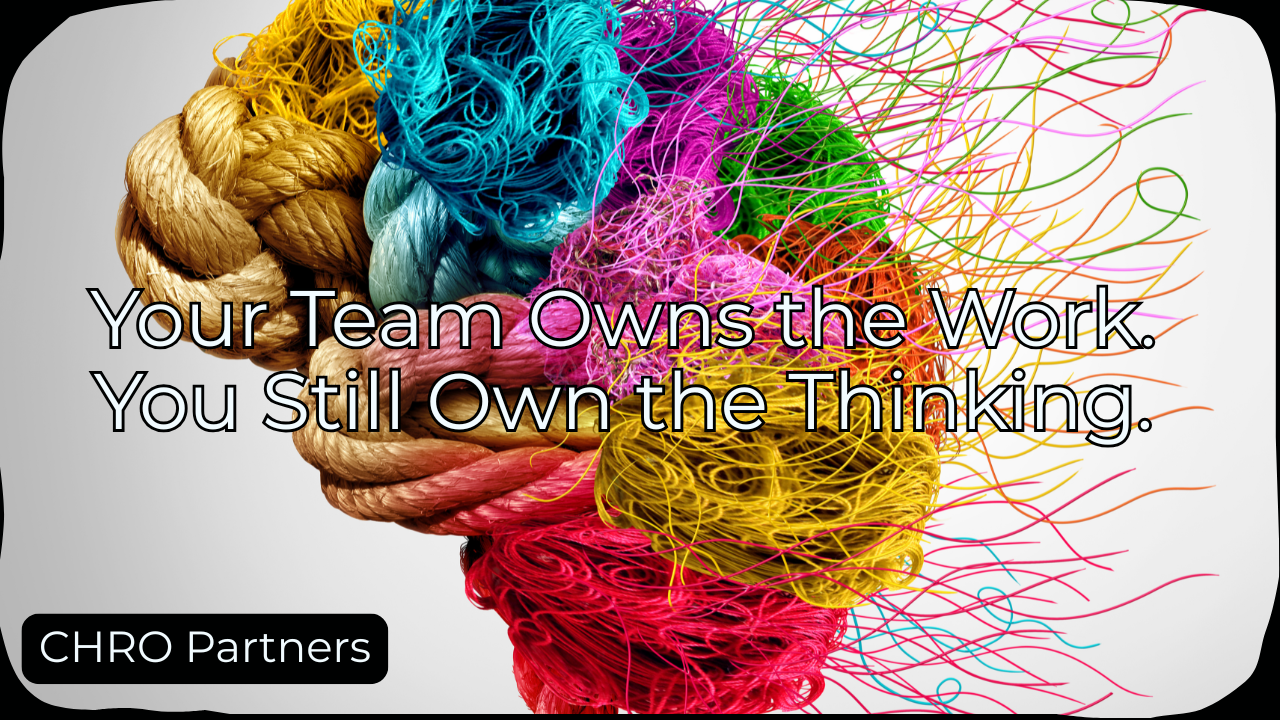
The thinking starts rolling uphill.
Another strategic-thinking rep, another execution rep
A leader brings the problem to the CHRO.
The CHRO starts asking questions.
"What is really going on here?" "What does the business need?" "What are we missing?" "What happens if we do nothing?" "What would the CFO say?" "What is your recommendation?"
And somewhere in that conversation, the CHRO begins doing what they are very good at.
They connect the dots. They reframe the issue. They spot the business implication. They see the executive objection coming. They generate three or four ways to solve it.
The HR leader walks away with a much better answer.
And executes it.
Which seems like good leadership.
Except there is a hidden problem.
The CHRO got another strategic-thinking rep. The HR leader got another execution rep.
Do that often enough and you can end up with a team that owns a lot of work but still depends on you for the thinking that matters most.
Who is doing the thinking when the answer is not obvious?
That is a very different problem than "my team needs to be more strategic."
And I think CHROs often misdiagnose it.
They try to fix it by giving people bigger projects. Removing tactical responsibilities. Creating HRBP roles. Restructuring the team. Hiring more senior talent. Teaching business acumen. Sending people to programs. Giving them executive exposure. Giving them AI tools.
All of those things can help.
But none of them necessarily answer this question:
Who is doing the thinking when the answer is not obvious?
The difference between an order taker and a consultative advisor
That is where judgment shows up.
Judgment is not simply knowing HR. It is not having more experience. It is not speaking confidently in a meeting.
It is the ability to walk into an unclear situation and figure out what matters.
A leader with judgment does not simply respond to the request.
They ask what problem the business is actually trying to solve. They understand how the company makes money and how the work gets done. They connect information that may look unrelated. They ask the next question. They use data and expertise to strengthen their thinking. They see implications other people may miss. They develop a point of view.
And then they advise.
Even when the recommendation is not what the business leader originally asked for.
That is the difference between an order taker and a consultative advisor.
That is judgment
I saw this modeled beautifully years ago by one of our CHRO Mastermind members.
A business leader insisted the company needed career paths.
It would have been easy for HR to say, "Got it," and start building career ladders.
Instead, she kept asking questions.
Why do employees believe they cannot grow here? How have people actually advanced in the company? What does the employee data tell us? What are managers doing in career conversations?
What she discovered was that career paths were not the real problem.
The organization lacked some of the foundations that make career growth possible.
Managers were not equipped to coach. Compensation structures were unclear. Employees equated development with getting a bigger title.
So instead of simply delivering the requested career-path solution, HR addressed the underlying system.
That is judgment.
Another time, while supporting a corporate marketing team at a large consumer packaged goods company, she listened as executives discussed launching products in the summer and having the field reset store coolers.
She understood something the corporate team did not.
Summer was peak selling season. The field did cooler resets months earlier.
Their strategy looked good in a conference room, but the operating reality meant it would not happen the way they expected.
So the HR leader spoke up.
Not about HR.
About the business.
Judgment is hard to teach in a slide deck
That is what I mean when I say the goal is not simply to have your team doing "strategic HR work."
The goal is to have HR leaders who can walk into the room without you and improve the thinking.
And that changes how development has to happen.
Because judgment is hard to teach in a slide deck.
You can teach frameworks. You can teach business acumen. You can expose people to executives.
But ultimately, judgment develops through repeated experience with messy situations where there is no obvious answer.
Judgment reps
What I have started thinking about as judgment reps.
One kind is a point-of-view rep.
Instead of bringing the CHRO information and asking, "What do you think we should do?"
The HR leader has to say:
Here is what I think is happening. Here are the options I considered. Here is what I recommend. Here is why.
Another is an executive-table rep.
Before walking into a meeting, the HR leader has to think beyond the HR portion of the agenda.
What matters to this business leader? What is happening financially? Operationally? With customers? What question should I ask? What point of view can I contribute?
Another is a connect-the-dots rep.
Take the data. The business strategy. The people implications. The external environment. The operating reality.
And answer:
So what? What does all of this mean? What should the business do differently because of it?
And then there is the rep I think we underestimate most.
The debrief.
I spent years in professional services watching people learn consultative skills this way.
A less experienced person would lead the client meeting.
The more experienced person would sit there.
Quietly.
Which, if you are good at solving problems, is much harder than it sounds.
Afterward, you had the curbside conversation.
What did you notice? Why did you ask that question? What do you think the client really meant? Where did the conversation change? What did you miss? What would you do differently next time?
That is where judgment begins to compound.
Coach the thinking instead of supplying the thinking
And it points to a subtle shift for CHROs.
The goal is not to stop coaching your team.
The goal is to coach the thinking instead of supplying the thinking.
There is a big difference.
When a team member comes to you with a problem, the fastest thing may be to say:
"Here are five ways you could handle it."
The developmental response is harder:
"What are the five ways you see?"
And then stay quiet.
That is the uncomfortable part.
Strong CHROs are often rewarded for seeing the answer quickly.
You have years of pattern recognition. You know what the CEO is going to ask. You can see the land mine before your team can. You can probably fix the recommendation in five minutes.
But your best strategic thinking can also become the thing your team leans on.
Not because they are incapable.
Because the system keeps giving the hardest reps back to you.
Where is the thinking still rolling uphill?
So one of the questions I think CHROs should start asking is:
Where is the thinking still rolling uphill?
Not just the work.
The thinking.
Where do people still need you to frame the issue? Where do they need you to generate the options? Where do they need you to interpret the business impact? Where do they need you to tell them what they think?
Those are probably your biggest development opportunities.
Because a transformed HR leader does not simply execute more independently.
They think differently. They come with a point of view. They advise instead of order-take. They understand the business well enough to challenge the requested solution. They bring data and expertise together instead of just reporting it. They see around corners. They contribute to the entire executive conversation, not just the HR part.
And eventually something important happens.
The business leader does not need the CHRO in every conversation to get high-quality thinking from HR.
That is when the CHRO finally gets to spend more time on the business instead of constantly dropping back inside HR.
Not because the team is doing more work.
Because the team can do more of the thinking.
And that may be the real next level of delegation.
Your team owns the work.
The question is whether you are ready to let them own more of the thinking too.
This is exactly the kind of thing we work through at The Big CHRO Event, our flagship gathering of 100+ sitting CHROs in Dallas each September, and in the CHRO Mastermind Groups that run year-round. If you are a sitting CHRO and you want a room of peers working on the same handoff, reach out and I will get you the details.
Request an invite to the Big CHRO Event the 2nd Friday each September.
For CHROs, CPOs and direct reports
